Registered Pharmacy100% OnlineNew here? Use code: WELCOME10 for 10% OFFFree Shipping Over £50Fully Inspected & Regulated ServicesApproved UK-licensed TreatmentsRegistered Pharmacy100% OnlineNew here? Use code: WELCOME10 for 10% OFFFree Shipping Over £50Fully Inspected & Regulated ServicesApproved UK-licensed Treatments
26 Sep 2026

11min read
Contents

A weight-loss plateau is when your weight stops falling despite continuing the same diet, activity, and medication. If you are on a prescription GLP-1 such as Wegovy or Mounjaro, the most important next step is a clinician review to check your adherence, dose, and any side effects.
If you experience any of the following, seek urgent medical attention rather than waiting for a routine review:
A plateau is not a sign that you have failed. It is a recognised, physiological event that most people experience at some point, and it is manageable with the right clinical support.
Your body is not working against you. It is adapting, and that distinction matters for how you respond.

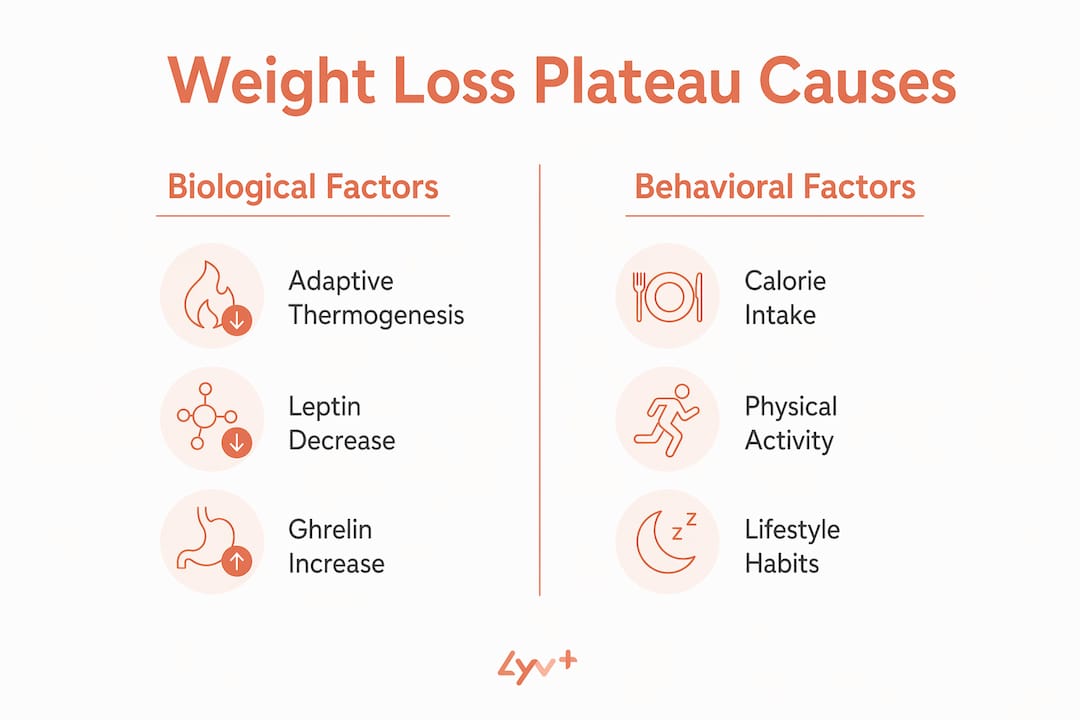
Adaptive thermogenesis is the main biological driver. As your body shrinks, it reduces its resting energy expenditure beyond what fat-free mass loss alone would predict. In plain terms: a smaller body burns fewer calories at rest, so the same food intake that once produced a deficit no longer does.
Hormonal shifts compound this. Leptin, which signals fullness, falls as fat mass decreases. Ghrelin, which drives hunger, tends to rise. The result is a body that is simultaneously burning less and wanting more.
As the British Heart Foundation's senior dietitian Victoria Taylor notes, the fastest weight loss in the early weeks often reflects fluid and glycogen depletion rather than fat loss. Sustainable fat loss after that initial phase is slower and steadier, typically around 0.5–1 kg per week. Setting expectations around that figure from the start prevents a normal slowdown from feeling like failure.
Behavioural causes are just as common:
Pro Tip: Early rapid loss is mostly water and stored glycogen, not fat. If your weight dropped quickly in week one or two, that is expected. Sustained fat loss is a slower process, and a plateau later on does not erase that earlier progress.
GLP-1 receptor agonists change the plateau timeline compared with lifestyle changes alone. They reduce appetite, slow gastric emptying, and support a calorie deficit that most people cannot sustain through willpower alone. The result is that plateaus with pharmacotherapy typically arrive later than they do with diet and exercise alone, often around the 6–12 month mark rather than the first few weeks.
The typical pattern looks like this:
Wegovy (semaglutide) and Mounjaro (tirzepatide) are the two GLP-1 treatments most commonly prescribed in the UK context. Both are used alongside lifestyle support, and both can produce plateaus as the body reaches a new equilibrium. A plateau on either medication does not automatically mean the treatment has stopped working. It may mean the dose, the lifestyle programme, or both need reviewing.
The key distinction is whether the plateau is biological or behavioural. A clinical review is the only reliable way to tell.
Knowing when to contact your prescriber is half the battle. Use this checklist as a guide.
Time-based triggers:
Symptom-based triggers:
What your clinician will check:
Pro Tip: Keep a simple weekly log: your weight on the same day each week, a note on appetite (1–5 scale), sleep hours, and any notable events (illness, travel, stress). Three to four weeks of this data makes a clinical review significantly faster and more productive.
A clinical review is not a tick-box exercise. It is a structured assessment of what has changed and what options are available. NHS pathways for GLP-1 prescriptions require ongoing monitoring and participation in a lifestyle programme, which means your prescriber already expects to review progress at regular intervals.
Common clinical actions at a plateau:
Possible next steps, depending on findings:
Pro Tip: Never adjust your dose or stop your GLP-1 abruptly without speaking to your prescriber first. Unsupervised changes carry real risks, including rapid return of appetite and potential side effects from incorrect titration.
NICE recommends GLP-1 medications as part of a managed programme, not as a standalone fix. The lifestyle component is not optional; it is what makes the medication work at its best.
These are safe to try between clinical reviews, but they work best alongside, not instead of, medical oversight.
Re-measure after 2–4 weeks. If nothing has shifted, that is your signal to book a review.
The number on the scale is one data point, not the whole picture. After the initial phase, NHS guidance suggests aiming for 0.5–1 kg per week as a healthy, sustainable rate. Plateaus lasting 2–4 weeks can be entirely normal, particularly after a period of faster loss.
Non-scale measures worth tracking:
A plateau lasting more than 4–6 weeks without any non-scale progress, and after lifestyle adjustments have been made, is the point at which clinical action is warranted.
Stopping or switching GLP-1 medication without clinical guidance carries real risks. Weight regain is common after stopping, particularly if the lifestyle changes that supported the medication have not been fully embedded. Appetite often returns quickly, sometimes more intensely than before.
Key safety points:
Pro Tip: If you are considering stopping because progress has stalled, book a review first. A dose adjustment or a targeted lifestyle change may be all that is needed to restart progress, and stopping prematurely often means starting again from scratch.
Any decision to change, escalate, or stop GLP-1 treatment should be made with your prescriber, in line with NICE and NHS guidance.
A weight-loss plateau on GLP-1 therapy is a normal physiological event, not a treatment failure, and a structured clinical review is the most effective first response.
Point - Details
Plateaus are physiological
Adaptive thermogenesis and hormonal shifts cause them; they are expected, not a personal failure.
GLP-1s delay but do not prevent plateaus
Wegovy and Mounjaro typically push the plateau to 6–12 months; lifestyle support remains essential throughout.
Sustainable loss rate
After the initial phase, 0.5–1 kg per week is a healthy, realistic target; short plateaus lasting a few weeks can be normal.
Clinical review is the key action
If weight has not changed for 4–6 weeks despite consistent adherence, request a prescriber review with logs ready.
Lyvpharmacy offers clinician-led assessment
Lyvpharmacy provides GLP-1 prescriptions (Wegovy, Mounjaro) with clinician assessment and next-day UK delivery.
Here is something worth saying plainly: the weight-loss plateau is one of the most misunderstood events in the entire process. Most of the frustration people feel at this stage comes not from the plateau itself, but from the expectation that weight loss should be linear. It never is, and GLP-1 therapy does not change that fundamental truth.
What GLP-1 medications do is shift the timeline and reduce the severity of the hunger signals that make plateaus so hard to push through without support. That is genuinely useful. But the medication cannot substitute for the clinical review that identifies whether a plateau is biological, behavioural, or both. Skipping that review, or worse, quietly stopping the medication out of frustration, is where most people lose ground they had worked hard to gain.
The six-month mark deserves particular attention. Clinicians treat it as a milestone precisely because both the physiology and the behaviour tend to shift there simultaneously. Patients who arrive at that point with a few weeks of weight, appetite, and sleep data are in a far stronger position than those who arrive with nothing but a number on the scale. Preparation is not bureaucracy. It is what makes the appointment actually useful.
The path forward from a plateau is rarely dramatic. It is usually a small dose adjustment, a dietary tweak, a sleep improvement, or a combination of all three. The people who navigate it best are those who treat it as a clinical question rather than a personal verdict.
If you are on Wegovy or Mounjaro and your progress has stalled, or if you are looking to start a clinician-prescribed GLP-1 programme, Lyvpharmacy offers a straightforward route to regulated, medically supervised care in the UK.
Every prescription at Lyvpharmacy follows a full clinician assessment, in line with NICE and NHS guidance. There are no mandatory subscriptions: you pay for your treatment and prescription, and repeat orders are available when clinically appropriate. Discreet next-day delivery means you are not waiting weeks for access.
Dose changes and treatment switches are handled through clinical review, not guesswork. If your plateau needs a prescriber's input, that is exactly what Lyvpharmacy is built for. Start your assessment or read more about clinician-guided weight loss to understand what medically supervised care looks like in practice.
This article provides general health information and does not constitute medical advice. Always consult a qualified prescriber or healthcare professional for guidance specific to your situation.