Registered Pharmacy100% OnlineNew here? Use code: WELCOME10 for 10% OFFFree Shipping Over £50Fully Inspected & Regulated ServicesApproved UK-licensed TreatmentsRegistered Pharmacy100% OnlineNew here? Use code: WELCOME10 for 10% OFFFree Shipping Over £50Fully Inspected & Regulated ServicesApproved UK-licensed Treatments
13 Sep 2026

10min read
Contents

GLP-1 receptor agonists are defined as a class of prescription medicines licensed for weight management in adults who meet specific clinical thresholds. The medical criteria for GLP-1 use centre on two core measurements: body mass index and the presence of weight-related health conditions. NICE guidelines set the standard in the UK, requiring a BMI of at least 30 kg/m² for straightforward eligibility, or at least 27 kg/m² when a qualifying comorbidity is present. These are not arbitrary numbers. They reflect the point at which excess weight creates measurable, treatable health risk. Understanding exactly where you or your patient sits against these thresholds is the starting point for any responsible prescribing decision.
Standard NICE guidance sets two clear BMI thresholds for GLP-1 eligibility. The first is a BMI of 30 kg/m² or above, which classifies as obesity. The second is a BMI of 27 kg/m² or above, provided the patient has at least one weight-related comorbidity. That second threshold is significant because it opens access to patients who carry serious health risk even without reaching the clinical definition of obesity.
The accepted comorbidities for the lower BMI threshold include:
These conditions are not simply listed for completeness. Each one carries independent mortality risk, and weight loss through GLP-1 therapy has demonstrated measurable benefit across all of them.

NICE recommends lowering BMI thresholds by 2.5 kg/m² for patients from South Asian, Chinese, Middle Eastern, Black African, or African Caribbean backgrounds. This matters because these populations carry greater cardiometabolic risk at lower BMI values than white European populations. A South Asian patient with a BMI of 27.5 kg/m² and hypertension, for example, may meet the adjusted criteria even though they fall below the standard threshold.
Eligibility verification goes well beyond a patient completing an online form. GPhC mandates direct two-way communication between prescriber and patient, plus independent verification of weight, height, and BMI. Self-reported measurements are not sufficient on their own. Verification must come through video consultation, in-person assessment, or confirmation via GP records.
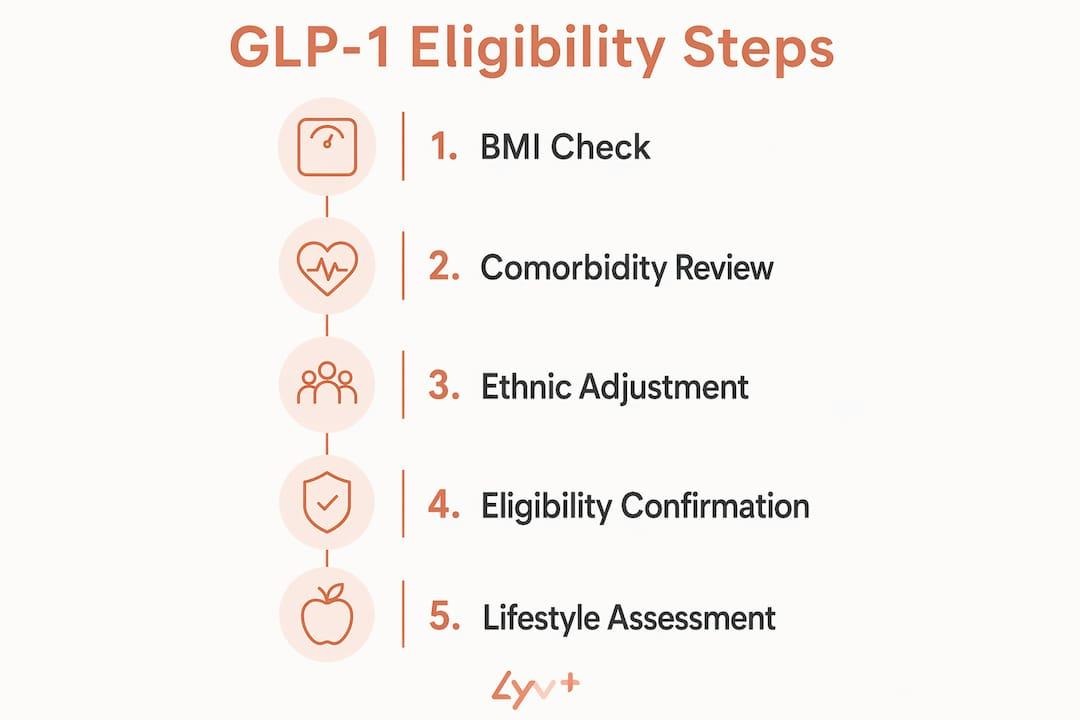
This standard exists for good reason. Weight and height are easy to misreport, whether intentionally or not, and the difference of a few kilograms can determine whether a patient genuinely qualifies. Responsible prescribing depends on objective data, not assumptions.
Screening must also cover psychological wellbeing. Practitioners must assess for eating disorders, body dysmorphia, and other mental health conditions before initiating treatment. A patient with active bulimia, for instance, may meet the BMI threshold but face significant risk from appetite-suppressing medication without specialist support in place.
Key steps in a thorough pre-prescribing assessment include:
Local ICBs often apply additional eligibility criteria beyond national guidance. Some require documented evidence of prior supported weight loss attempts within the past two years. Others exclude patients with unstable mental illness. These regional layers mean that national NICE criteria alone do not guarantee access in every area.
Pro Tip:Always confirm which ICB your patient falls under before discussing treatment timelines. Regional restrictions can affect eligibility even when national criteria are clearly met, and setting accurate expectations early prevents frustration later.
GLP-1 therapy is not indefinite by default. Clinical benchmarks determine whether treatment continues or stops, and these benchmarks are built into the prescribing framework from the outset.
NICE guidance recommends stopping GLP-1 therapy if a patient has not lost at least 5% of their initial body weight by the six-month mark. That threshold reflects the minimum level of response considered clinically meaningful. If the medication is not producing measurable results by that point, continuing it carries cost and side-effect burden without proportionate benefit.
Common reasons to discontinue treatment include:
When treatment stops, patients receive structured advice on weight maintenance and long-term health improvement. This handover matters because weight regain is common after discontinuation without ongoing support.
GLP-1 medications are licensed only as adjuncts to a reduced-calorie diet and increased physical activity. Medication alone does not produce sustainable results. The behavioural and dietary changes must be in place before treatment starts and must continue throughout. Prescribing without this foundation in place is not consistent with the licensing conditions.
Pro Tip:Frame the six-month review as a positive checkpoint, not a threat. Patients who understand the review criteria from the start are more likely to engage with dietary and lifestyle changes that support their response to medication.
The gap between national guidance and local access is one of the most practically significant issues in GLP-1 prescribing. NICE sets the floor, but ICBs can raise it considerably.
ICBs may impose restrictions based on social deprivation indices, recent bariatric surgery, or specific comorbidity profiles. Some prioritise patients with the highest cardiovascular risk. Others require that patients have completed a formal weight management programme before accessing medication. This creates a postcode effect where two patients with identical clinical profiles may have very different access depending on where they live.
Key prescribing nuances to keep in mind:
On that last point: no validated dose equivalence exists for switching between GLP-1 medications. If a patient moves from one agent to another due to side effects or supply issues, the safest approach is to begin the new prescription at the lowest available dose and titrate upward. Attempting to match doses across different agents is not supported by evidence and increases the risk of adverse effects.
Scenario - Recommended approach
Switching GLP-1 agent
Start at lowest dose; titrate from there
Patient from high-risk ethnic group
Apply adjusted BMI threshold (reduce by 2.5 kg/m²)
ICB requires prior weight loss attempt
Document formally before referral
Unstable mental illness identified
Defer prescribing; refer for specialist support first
GLP-1 medications should only be considered after formal evaluation of dietary, exercise, and behavioural approaches. Medication is an adjunct to these foundations, not a replacement for them. This is not a caveat buried in the small print. It is a core condition of the licence and a clinical reality: patients who do not change their eating and activity habits alongside medication see significantly poorer outcomes.
The role of a multidisciplinary team is central to good practice here. Dietitians, behavioural support practitioners, and GPs each contribute to a plan that medication alone cannot deliver. Clinical effectiveness of GLP-1 therapy depends significantly on concurrent behavioural support, and delivering that support consistently remains a funding and capacity challenge across the NHS.
For patients and practitioners alike, the practical implications are clear:
You can read more about what clinician-guided weight loss actually involves in practice, including what to expect from a structured assessment and ongoing monitoring. The medication is one part of a larger, coordinated effort.
GLP-1 therapy eligibility in the UK is defined by NICE BMI thresholds, qualifying comorbidities, and mandatory lifestyle support, with regional ICB criteria adding further layers that practitioners and patients must verify before treatment begins.
Point - Details
Core BMI thresholds
NICE requires BMI ≥30 kg/m², or ≥27 kg/m² with at least one qualifying comorbidity.
Ethnic adjustments apply
BMI thresholds reduce by 2.5 kg/m² for South Asian, Chinese, Middle Eastern, Black African, and African Caribbean patients.
Verification is mandatory
GPhC requires objective BMI confirmation via video, in-person, or GP records. Online questionnaires alone are insufficient.
Six-month review is binding
Treatment stops if weight loss is under 5% of starting body weight at six months.
Regional ICB criteria vary
Local boards may add requirements such as prior weight loss attempts or mental health exclusions beyond NICE guidance.
The criteria look straightforward on paper. A BMI number, a comorbidity, a tick in the right box. But the reality of applying these guidelines is considerably more nuanced, and the patients who do best are rarely the ones who just scraped through the eligibility threshold.
What strikes me most is how often the conversation about criteria stops at BMI and never reaches behavioural readiness. A patient can meet every clinical threshold and still not be in the right place to get meaningful benefit from medication. Appetite suppression without a plan for what to eat, how to move, and how to manage the psychological side of weight loss is a short-term fix at best. The criteria for GLP-1 prescription are a starting point, not a guarantee of success.
The regional variation in ICB criteria is also something that does not get enough attention. Patients who have done everything right, lost weight through a structured programme, managed their comorbidities, and come prepared, can still find themselves blocked by a local policy that was written without their specific situation in mind. That is genuinely frustrating, and it is worth being honest about rather than glossing over.
My practical advice: treat the eligibility criteria as the beginning of the clinical conversation, not the end of it. The most responsible prescribing happens when the numbers are verified, the psychological picture is clear, and the patient understands what the medication can and cannot do. That combination produces results. The tick-box approach, on its own, does not.
— Lyv
Lyvpharmacy is built around the principle that access to GLP-1 therapy should be fast, safe, and properly supported. Every patient goes through a clinician-led assessment that follows the medical eligibility criteria set by NICE and the GPhC, including objective BMI verification and a review of relevant health history.
If you are ready to find out whether you qualify, or you want to understand your options before committing to anything, Lyvpharmacy’s weight loss treatments page gives you a clear overview of what is available and how the process works. From Wegovy to Mounjaro, every treatment is prescribed under medical supervision with ongoing support built in. No shortcuts, no guesswork, and no pressure. Just a clear, medically grounded path forward.