Registered Pharmacy100% OnlineNew here? Use code: WELCOME10 for 10% OFFFree Shipping Over £50Fully Inspected & Regulated ServicesApproved UK-licensed TreatmentsRegistered Pharmacy100% OnlineNew here? Use code: WELCOME10 for 10% OFFFree Shipping Over £50Fully Inspected & Regulated ServicesApproved UK-licensed Treatments
31 Aug 2026

9min read
Contents

Injections are defined as a method of delivering medication directly into the body's tissues or bloodstream, bypassing the digestive system entirely. This distinction matters enormously when you are weighing up why injections over pills is such a common recommendation from clinicians treating weight management, joint pain, or chronic health conditions. The pharmacological term for this advantage is bioavailability, which simply means how much of a drug actually reaches your system in an active form. Pills must survive your stomach acid, your gut lining, and your liver before a fraction of the dose does any useful work. Injections skip all of that.
The core reason clinicians favour injections comes down to bioavailability. Oral semaglutide bioavailability sits at only around 1–2%, meaning the vast majority of the pill dose is lost before it reaches the bloodstream. Injectable semaglutide delivers close to 100% of the active compound directly into circulation. That is not a marginal difference. It is the difference between a treatment that works reliably and one that depends on a long chain of conditions being met perfectly.
Oral peptide drugs like semaglutide require special chemical formulation just to survive the gastrointestinal tract. Even with that formulation, gut enzymes degrade much of the compound before absorption occurs. Injections bypass this entirely, which is why injection dosing produces consistent blood drug levels that oral administration simply cannot match.

The clinical outcomes reflect this gap. Injectable semaglutide users lost an average of 14.9% of body weight over 68 weeks. Oral semaglutide users lost 13.6% over 64 weeks. Both results are meaningful, but the injection route consistently delivers more. For someone managing obesity or a weight-related health condition, that difference compounds over time.
Key factors that reduce oral drug absorption include:
Pro Tip: If you are taking an oral GLP-1 medication, missing the fasting window even once can significantly reduce that dose's effectiveness. Injections remove this variable entirely.
The advantages of injections are not purely pharmacological. How a medication fits into your daily life determines whether you actually take it consistently, and consistency is what drives results.
Oral pills typically require daily dosing, often with strict timing requirements. Oral GLP-1 pill effectiveness can drop by 30–40% if not taken under strict conditions, including fasting and no other intake for 30 minutes. That is a demanding routine to maintain every single day, especially for people with busy or unpredictable schedules.
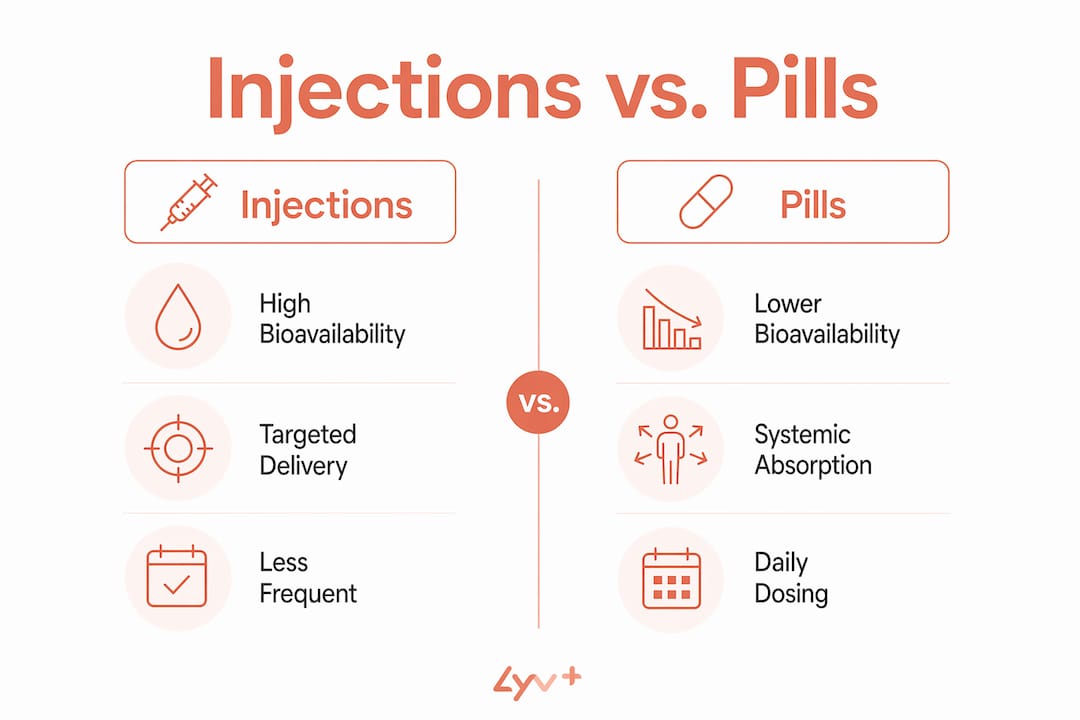
Injectable treatments like Wegovy and Mounjaro are administered once weekly. Once-weekly injections remove the strict daily timing constraints of oral pills, which makes adherence considerably easier for most patients. You pick one day a week, administer the injection, and move on. There is no fasting window to manage, no risk of forgetting a daily dose, and no interaction with breakfast.
The practical considerations worth thinking through include:
Pro Tip: If needle anxiety is your main concern, ask your clinician about auto-injector devices. Many patients find that after the first two or three uses, the process feels entirely routine.
Both injectable and oral GLP-1 therapies share a similar side effect profile, because they work through the same biological mechanism. Nausea, vomiting, and gastrointestinal discomfort are the most commonly reported effects across both routes. The difference lies in intensity and where those effects originate.
Oral pills interact directly with the gut before entering the bloodstream, which can amplify gastrointestinal side effects. Injections deliver the drug systemically, so gut-related effects tend to be milder for many patients. Injection site reactions, such as redness, swelling, or mild bruising, are specific to the injectable route and are generally short-lived.
Discontinuation rates tell a useful story. Side effect discontinuation rates in clinical trials were 5–10% for oral GLP-1 pills and 6–8% for injectable semaglutide. The rates are broadly comparable, which means neither route is dramatically harder to tolerate than the other. What differs is the type of side effect, not the overall likelihood of experiencing one.
Common side effects by route:
Managing side effects well is largely about dose titration. Both injectable and oral treatments start at a low dose and increase gradually, giving your body time to adjust. Patients who rush this process tend to experience more discomfort. Those who follow the titration schedule typically find side effects settle within the first few weeks.
Weight management is one context where injections outperform pills. Joint and musculoskeletal conditions are another, and the reasoning is different but equally compelling.
When a clinician injects a corticosteroid or hyaluronic acid directly into a joint, the medication reaches the exact site of inflammation or degeneration at a high concentration. Injections allow targeted delivery of medication directly to tissues, minimising systemic exposure and side effects compared to oral anti-inflammatory pills. An oral anti-inflammatory, by contrast, circulates through your entire body to reach the affected joint, exposing every organ to the drug along the way.
Clinicians prefer injection therapy for musculoskeletal conditions because it achieves a higher medication concentration at the site of inflammation, producing better outcomes with less systemic risk. This is particularly relevant for patients who cannot tolerate long-term oral anti-inflammatory use due to gastrointestinal or cardiovascular risks.
The duration of relief also favours injections. Corticosteroid injections provide pain relief lasting 3–4 months, while hyaluronic acid injections last around 6 months. Oral anti-inflammatory pills require daily dosing and carry cumulative risks with prolonged use. A single injection appointment can deliver months of relief that a daily pill regimen cannot replicate.
Pro Tip: Localised injection therapy is not just for severe cases. Clinicians increasingly use it as a first-line, non-surgical option for conditions like knee osteoarthritis, shoulder bursitis, and tennis elbow, where targeted relief is the goal.
Injection therapy also represents a proactive, non-surgical path for patients who want to manage pain without escalating to surgery. The concentration of medication at the target site, combined with minimal systemic exposure, makes it a clinically sound choice for many conditions that oral medication handles less precisely.
Injections outperform pills in bioavailability, dosing consistency, and targeted delivery, making them the clinically preferred route for many weight management and musculoskeletal treatments.
Point - Details
Bioavailability gap
Oral semaglutide absorbs at only 1–2%; injectable semaglutide delivers close to 100% into the bloodstream.
Weight loss outcomes
Injectable semaglutide produced 14.9% body weight loss versus 13.6% for the oral form in clinical trials.
Dosing simplicity
Once-weekly injections remove daily fasting requirements, making adherence easier for most patients.
Targeted relief
Corticosteroid injections provide 3–4 months of joint pain relief; hyaluronic acid injections last around 6 months.
Tolerability
Discontinuation rates are comparable across both routes, so neither is dramatically harder to tolerate.
I have seen patients arrive convinced that a pill is the easier option, and I understand why. Pills feel familiar. Injections feel like a bigger commitment. But the clinical picture tells a more nuanced story, and I think it is worth being honest about what that means for real people.
The patients who do best with injectable treatments are not necessarily the ones who felt confident from the start. They are the ones who got clear information, tried the auto-injector with support, and realised within a few weeks that the process was far simpler than they had imagined. Patients wary of injections can often overcome needle fear through education and simplified devices, and the adherence improvements that follow are genuinely significant.
What I find most telling is the lifestyle fit question. A once-weekly injection suits people who travel, work irregular hours, or simply do not want a daily medical routine built around fasting windows. That is not a minor convenience. It is a meaningful difference in how sustainable a treatment feels over months and years. Patient lifestyle and priorities strongly influence which route succeeds long term, and successful injectable use often removes the clinical need to switch to an oral alternative at all.
My honest view is this: do not let needle anxiety make the decision for you. Let the clinical evidence and your own lifestyle inform the choice, with a clinician who knows your situation. That combination produces better outcomes than either route alone.
— Lyv
If you are weighing up injectable versus oral treatments for weight management, having a clinician in your corner makes the difference between guessing and knowing.
Lyvpharmacy provides clinician-led access to prescription GLP-1 treatments including Wegovy and Mounjaro, with online assessments, rapid approvals, and discreet home delivery. Every prescription is reviewed by a qualified clinician, so you get the right treatment for your situation, not a one-size-fits-all recommendation. You can browse the full range of weight loss treatments available through Lyvpharmacy, or read more about what clinician-guided care actually means in practice. The process is built to be fast, safe, and straightforward from first assessment to repeat prescription.
Recommended