Registered Pharmacy100% OnlineNew here? Use code: WELCOME10 for 10% OFFFree Shipping Over £50Fully Inspected & Regulated ServicesApproved UK-licensed TreatmentsRegistered Pharmacy100% OnlineNew here? Use code: WELCOME10 for 10% OFFFree Shipping Over £50Fully Inspected & Regulated ServicesApproved UK-licensed Treatments
23 Sep 2026

9min read
Contents

Appetite suppressants are medicines or interventions that reduce hunger signals. In the UK, the most clinically significant examples are prescription GLP-1 receptor agonists: semaglutide (Wegovy) and tirzepatide (Mounjaro). These are not over-the-counter slimming aids. They are prescription-only medicines that require a clinical assessment by a qualified healthcare professional before any prescription can be issued.
If you are considering this route, here is what matters most right now:
Pro Tip: Before you search for a prescription online, check that the provider is registered with the Care Quality Commission (CQC) and that a named clinician will review your medical history. That step protects you from counterfeit products and dosing errors.
Most people think of appetite suppression as simply "feeling less hungry." GLP-1 receptor agonists do that, but the mechanism goes considerably deeper. Semaglutide mimics a natural gut hormone to increase fullness signals and slow gastric emptying, so food stays in your stomach longer and hunger returns more slowly after a meal.
Beyond the gut, these medicines act on appetite centres in the brain, particularly the hypothalamus, reducing what many patients describe as "food noise": the persistent, intrusive thoughts about eating that make calorie control so difficult. NHS Inform describes this reduction in food-related thoughts as one of the most meaningful effects patients report, distinct from simple hunger suppression.
GLP-1 medicines are potent metabolic medications requiring long-term management and medical oversight. Regulatory guidance is clear that these are therapy options for people with obesity or related conditions, not short-term cosmetic fixes.
That distinction matters for how you plan treatment. Clinical and regulatory guidance frames GLP-1s as metabolic therapy, not a temporary appetite trick. Stopping the medicine without addressing diet and activity generally leads to weight returning.
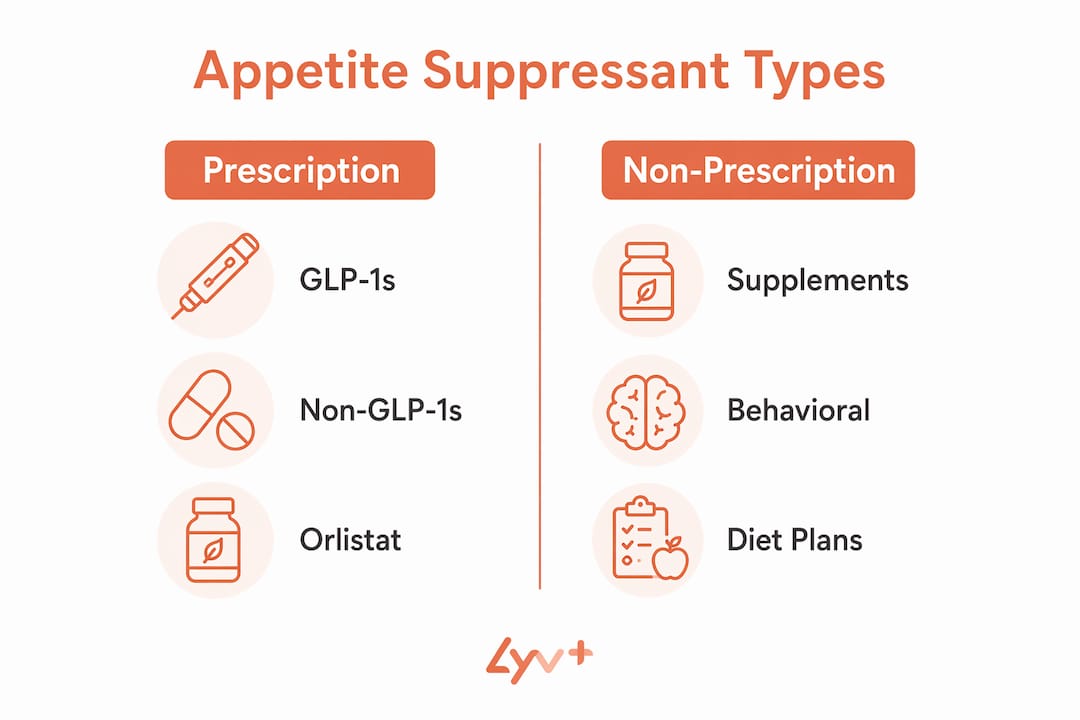
Not all appetite suppressants are equal, and the differences in regulation, evidence, and safety are significant.
Prescription GLP-1 receptor agonists
Non-GLP-1 prescription options
Orlistat (Xenical) works differently, blocking fat absorption in the gut rather than acting on appetite centres. It has a longer prescribing history but produces more modest weight loss and carries gastrointestinal side effects that many patients find difficult to manage.

Over-the-counter products and supplements
Glucomannan, green tea extract, and various "fat burner" supplements are widely sold but are not regulated as medicines. Evidence for meaningful weight loss is weak, and none are subject to the same safety and efficacy standards as licensed medicines. Treat them with caution.
Behavioural approaches
Structured reduced-calorie eating plans, increased physical activity, and cognitive behavioural techniques are not optional extras. They are clinically required companions to any medication. Without them, the benefits of GLP-1 treatment are limited and weight regain after stopping is likely.
Appetite reduction is gradual. You will not feel dramatically different after your first injection. The medicine is titrated slowly, starting at a low dose and increasing over weeks or months to reduce gastrointestinal side effects such as nausea and constipation. Maximum appetite suppression typically takes several months to establish.
What typically happens:
Low starting dose; mild nausea possible; modest appetite change
Dose increases; appetite suppression becomes more noticeable
Clinical review: ≥5% bodyweight loss expected to continue treatment
Trials report 10–15% average bodyweight loss with leading agents
The NICE stopping rule is clear: if you have not lost a clinically meaningful amount of your starting bodyweight by six months, treatment should be reviewed and may be discontinued. This is not a failure; it is a clinical signal that the medicine may not be the right fit for you.
Even modest weight loss produces measurable improvements in blood pressure, blood sugar control, and liver fat — benefits that go well beyond the number on the scales.
Pro Tip: Keep a simple weekly log of your weight, appetite, and any side effects. This makes your six-month clinical review far more useful and helps your clinician adjust your plan with real data rather than estimates.
The most common side effects are nausea, constipation, and diarrhoea. These are usually dose-dependent and improve as your body adjusts, which is why titration is so important. Dizziness, headaches, and injection-site reactions also occur.
Key contraindications and monitoring points to discuss with your clinician:
Buying GLP-1 medicines from unregulated sellers — social media, unauthorised websites, or aesthetic clinics — risks receiving counterfeit or incorrectly dosed products. Regulatory warnings are explicit: bypassing clinical assessment is not just unsafe, it is illegal under UK medicines law.
This is not a theoretical risk. Documented cases exist of patients self-administering doses far higher than prescribed after obtaining medicines from unregulated sources, resulting in serious adverse effects.
A clinical assessment by a qualified healthcare professional is the legal and clinical starting point. No regulated provider can issue a prescription without one.
The assessment is not a formality. It is the step that determines whether this medicine is safe and appropriate for you specifically, given your medical history, current medications, and weight-related conditions.
NHS pathway: Your GP can refer you to specialist weight management services if you meet NICE criteria (typically BMI ≥35 kg/m² with a comorbidity, or ≥30 kg/m² in some circumstances). Tirzepatide is now available in both primary and secondary care following the December 2024 NICE recommendation, though rollout is phased. Waiting times vary considerably by area.
Private clinician-led online clinics: A regulated online clinic such as Lyvpharmacy offers a remote clinical assessment, clinician oversight, a regulated prescription, and discreet home delivery. The process typically covers your medical history, BMI, comorbidities, current medications, and any contraindications. To understand how to qualify for weight loss medication and what the assessment involves, Lyvpharmacy's eligibility guide sets it out clearly.
GLP-1 receptor agonists such as semaglutide (Wegovy) and tirzepatide (Mounjaro) are the most clinically effective prescription appetite-suppressing medicines available to UK patients, requiring a clinical assessment, ongoing monitoring, and lifestyle changes to produce lasting results.
Point - Details
GLP-1s are metabolic medicines
Semaglutide and tirzepatide are prescription-only; they are not cosmetic or short-term aids.
Clinical benchmark at six months
NICE guidance requires ≥5% bodyweight loss by month six for treatment to continue.
Titration takes time
Doses increase gradually over weeks; meaningful appetite suppression builds over months, not days.
Avoid unregulated sellers
Counterfeit and incorrectly dosed products are a documented risk from unverified online sources.
Lyvpharmacy's route
Clinician-led assessment, regulated prescription, and home delivery for eligible UK patients.
The conversation I find most useful with patients is not about the number on the scales. It is about food noise. Many people who struggle with their weight are not simply lacking willpower; they are dealing with a near-constant mental preoccupation with food that makes every meal a negotiation. GLP-1 medicines quiet that noise in a way that diet plans alone rarely achieve.
That said, the medicine is a tool, not a solution on its own. Titration matters enormously. Patients who rush to a higher dose to accelerate results often experience nausea that undermines adherence, and adherence is what drives outcomes. The six-month review is not a hurdle; it is a genuinely useful checkpoint that protects patients from continuing a treatment that is not working for them.
What I appreciate about a clinician-led model is the follow-up structure. Prescribing and disappearing is not good medicine. Patients need someone to contact when side effects appear, someone to adjust the plan when progress stalls, and someone who treats them as an individual rather than a data point. That ongoing relationship is where the real value sits, and it is what separates a regulated clinical service from an unregulated seller.
If you are ready to explore whether prescription GLP-1 treatment is right for you, Lyvpharmacy offers a straightforward, clinician-led route. Every patient starts with a thorough clinical assessment conducted by a qualified healthcare professional, covering your medical history, BMI, comorbidities, and current medications.

From there, eligible patients receive a regulated prescription, a personalised titration plan, and ongoing clinical follow-up built around your progress. Medicines are delivered discreetly to your home, with monitoring and support throughout. There are no long waiting lists and no need to navigate a GP referral pathway if you do not meet NHS criteria yet. Browse Lyvpharmacy's weight loss treatments to see the options available and start your clinical assessment today.
This article provides general information about appetite suppressants and GLP-1 medicines. It is not a substitute for professional medical advice. Please consult a qualified clinician or your GP to confirm whether these treatments are appropriate for your individual circumstances.