Registered Pharmacy100% OnlineNew here? Use code: WELCOME10 for 10% OFFFree Shipping Over £50Fully Inspected & Regulated ServicesApproved UK-licensed TreatmentsRegistered Pharmacy100% OnlineNew here? Use code: WELCOME10 for 10% OFFFree Shipping Over £50Fully Inspected & Regulated ServicesApproved UK-licensed Treatments
30 Aug 2026

9min read
Contents
Digital healthcare for weight loss is the use of technology-driven programmes and platforms that support weight management through behaviour change, remote monitoring, and clinician guidance without requiring in-person visits. The industry term is "digital weight management" or "digital therapeutics for obesity," and it covers everything from standalone apps to fully supervised telehealth services. Platforms like Oviva Direkt, the Voy platform, and Walgreens Weight Management have already demonstrated that this model delivers real, measurable results. If you are weighing up your options, the evidence is clear: digital solutions are not a compromise on quality. For many people, they are the better choice.
The most important question to answer first is whether digital weight loss solutions actually work. The short answer is yes, and the evidence is growing fast.
A 2026 JMIR meta-analysis confirmed that stand-alone digital lifestyle interventions produce statistically significant improvements in weight and dietary outcomes in adults with overweight or obesity. This was rated as moderate-certainty evidence, which means the findings are reliable enough to inform clinical decisions, not just academic debate.
The Oviva Direkt app provides a concrete example. A randomised controlled trial published in December 2025 showed that users achieved clinically relevant weight loss of more than 5% at six months compared to standard care. That threshold matters because a 5% reduction in body weight is the point at which meaningful health improvements, including better blood pressure and blood sugar control, typically begin.
The numbers become even more striking when medication is added to the mix. Participants who combined tirzepatide with active digital engagement lost 22.9% of body weight at 12 months, compared to 17.6% for those who took the medication without engaging with the digital tools. That 5.3 percentage point difference was attributed specifically to coaching, self-monitoring, and medication adherence supported through the app. Digital engagement is not a nice-to-have addition. It is a measurable driver of outcomes.
"Behavioural components like regular weight tracking and coaching bolster adherence and results." — 2026 retrospective cohort study on digital engagement and weight loss
The mechanisms behind these results are consistent across studies:
Not all digital weight loss programmes are built the same way, and that distinction matters when you are choosing one.
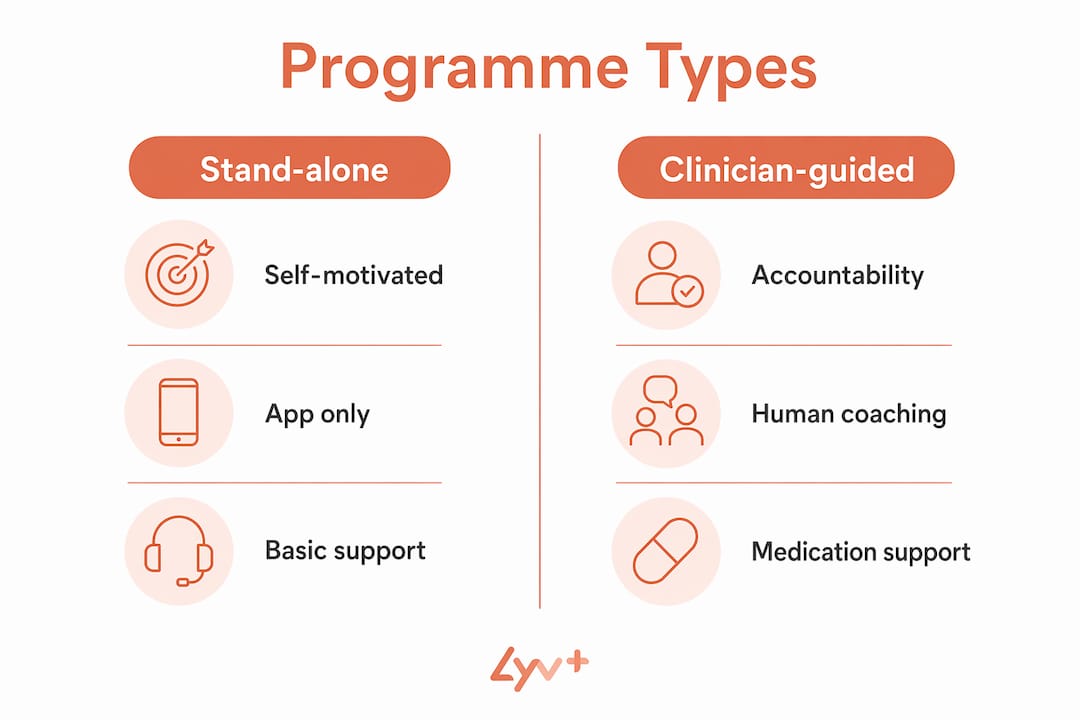
Stand-alone apps, those without any synchronous human contact, do produce results as the JMIR meta-analysis confirms. But the evidence also shows that adding therapeutic support tends to improve outcomes further. A network meta-analysis on support levels in internet-based interventions found greater effectiveness and lower dropout rates when human support was included compared to unsupported app-only tools. Lower dropout is significant because consistency is the single biggest predictor of long-term weight loss success.
The Walgreens Weight Management programme illustrates what a clinician-guided digital model looks like in practice. It offers licensed clinician video visits, FDA-approved GLP-1 prescribing, and on-demand follow-up appointments, available seven days a week from 7 a.m. to 11 p.m. The self-pay model charges $49 per visit with no monthly subscription. This structure gives users clinical oversight without locking them into a rigid contract.
The practical implication is that your choice of programme should reflect your own needs for accountability and safety.
Programme typeBest suited forTypical support level
Stand-alone app
Self-motivated users, mild weight loss goals
Automated feedback, tracking tools
Hybrid digital model
Users wanting occasional guidance
Periodic clinician check-ins, messaging
Clinician-led telehealth
Users on medication or with complex needs
Video consultations, prescribing, follow-up
Pro Tip: If you are considering a prescription weight loss medication such as a GLP-1 injection, choose a programme that includes clinician oversight rather than an app-only solution. Medication management requires professional input, and the clinician-guided approach significantly reduces the risk of side effects being mismanaged.
Beyond clinical outcomes, the practical case for digital weight management is strong. Four advantages stand out consistently.
Digital health applications are also recognised as scalable public health tools, particularly in resource-constrained environments. That scalability means more people can access support without the system being overwhelmed, which is a meaningful advantage as obesity rates continue to rise across the UK.
GLP-1 receptor agonists such as Wegovy (semaglutide) and Mounjaro (tirzepatide) are now central to evidence-based obesity treatment. Understanding how digital healthcare supports their use is increasingly important.
The Walgreens model demonstrates the full integration possible within a digital framework: a licensed clinician conducts a video consultation, assesses eligibility, prescribes an appropriate GLP-1 medication, and schedules follow-up visits to monitor progress and manage side effects. The entire pathway happens remotely. This is not a workaround. It is a clinically sound model that mirrors what a good in-person service would offer, delivered through a screen.
The data on combining digital engagement with GLP-1 treatment is compelling:
This matters because GLP-1 medications work best when used correctly and consistently. Missing doses, stopping early due to unmanaged side effects, or not pairing medication with behavioural change all reduce efficacy. A digital programme that supports adherence is not a luxury. It is part of what makes the treatment work.
Pro Tip: Before starting any GLP-1 treatment through a digital platform, read up on how these medications work and what to expect. Lyvpharmacy's guide on GLP-1 medications covers the evidence, the side effects, and the realistic outcomes in plain language.
Pricing models across digital medication programmes vary considerably. Some charge per visit with no subscription, as Walgreens does. Others use monthly fees that bundle medication, coaching, and delivery. Clarity on what you are paying for, and what clinical support is included, should be a non-negotiable part of your decision.
Digital healthcare for weight loss works best when it combines self-monitoring, coaching, and clinical oversight, particularly when prescription medications are involved.
Point - Details
Evidence is solid
Stand-alone digital interventions produce significant weight loss, confirmed by a 2026 JMIR meta-analysis with moderate-certainty evidence.
Human support improves outcomes
Clinician-guided programmes show lower dropout and better results than app-only tools, especially for medication users.
Practical advantages are real
Digital care costs less, removes access barriers, and reduces stigma compared to traditional in-person services.
GLP-1 integration is a game-changer
Combining tirzepatide with digital engagement produced 22.9% weight loss at 12 months versus 17.6% without engagement.
Match the programme to your needs
Choose between stand-alone apps, hybrid models, or full telehealth based on your goals, accountability needs, and whether medication is involved.
I have spent a lot of time looking at how people actually use digital weight loss programmes, and the pattern that stands out most is the gap between what people expect and what they actually need. Most people start by looking for the cheapest or most convenient option. That is understandable. But the programmes that produce lasting results are the ones that match the level of support to the individual, not just the lowest price point.
The evidence on stand-alone apps is genuinely encouraging. Oviva Direkt's RCT results are not trivial. But I would be cautious about recommending an app-only approach to anyone considering prescription medication. The side effect profile of GLP-1 injections, particularly in the early weeks of dose escalation, requires someone qualified to help you navigate it. An algorithm cannot do that.
What I find most interesting about the current moment is that the best digital programmes are not trying to replace clinical care. They are making clinical care more accessible. The Walgreens model, for all its US-specific pricing, shows what is possible: a licensed clinician, a video call, a prescription, and follow-up support, all without a waiting room. That is not a lesser version of healthcare. For many people, it is a better one.
The technology in weight loss is advancing quickly, but the fundamentals have not changed. Consistency, accountability, and appropriate clinical oversight are still what drive results. The best digital programmes simply make those things easier to maintain over time.
— Lyv
If you are ready to explore clinician-led digital weight loss, Lyvpharmacy is built for exactly this. Every patient starts with a clinical assessment carried out by licensed clinicians, and access to prescription treatments including Wegovy and Mounjaro is available without the delays of traditional routes.
There are no lengthy waiting lists and no monthly subscription traps. Lyvpharmacy's model is built around fast, safe access to weight loss treatments online with the clinical oversight that makes them work. If you want to understand more about the medications before you begin, the Lyvpharmacy guide on GLP-1 treatments is the clearest starting point available.
Recommended