 Registered Pharmacy100% OnlineNew here? Use code: WELCOME10 for 10% OFFFree Shipping Over £50Fully Inspected & Regulated ServicesApproved UK-licensed TreatmentsRegistered Pharmacy100% OnlineNew here? Use code: WELCOME10 for 10% OFFFree Shipping Over £50Fully Inspected & Regulated ServicesApproved UK-licensed Treatments
22 Jul 2026

8min read
Contents

The difference between online and in-person weight loss comes down to how care is delivered, not how effective it is. Research shows that medically supervised virtual programmes produce comparable, and in some cases better, outcomes than face-to-face clinics. A 2022 study found that virtual participants lost 8.2 lbs compared to 5.2 lbs in the in-person group, with an 81% retention rate versus 51%. Both formats can work well. The real question is which one fits your life, your medical needs, and the way you stay accountable.
The clinical term for remote weight loss care is telehealth or telemedicine weight management. Online weight loss programmes deliver consultations, prescriptions, and follow-up support entirely through video calls and digital platforms. In-person programmes take place at a physical clinic, where a clinician examines you directly, draws blood on-site, and may dispense medication the same day.
Both models operate under medical supervision when done properly. The distinction is not about quality. It is about logistics, access, and the type of clinical interaction involved. Providers like Tactus Health and Body Balance Medical have published detailed comparisons of both models, and the evidence consistently points to efficacy depending on care comprehensiveness rather than the setting itself.

GLP-1 medications such as semaglutide and tirzepatide are now central to both formats. Whether prescribed via video consultation or a clinic appointment, these treatments require proper evaluation and ongoing medical oversight. The delivery method does not change that requirement.
Understanding the practical workflow of each model helps you set realistic expectations before committing to either.
Online weight loss programmes typically follow this structure:
In-person clinics operate differently:
The scheduling cadence matters more than most people realise. Provider continuity throughout your programme, seeing the same clinician rather than rotating staff, directly improves the quality of personalised adjustments and outcomes. This applies equally to both formats, but it is worth asking about explicitly when you sign up.
Pro Tip:Before starting any programme, ask directly whether you will see the same clinician at each appointment. Rotating staff means starting from scratch every visit, which reduces the quality of care regardless of whether it is online or in person.
Neither format is universally superior. Each has genuine strengths and real trade-offs depending on your circumstances.
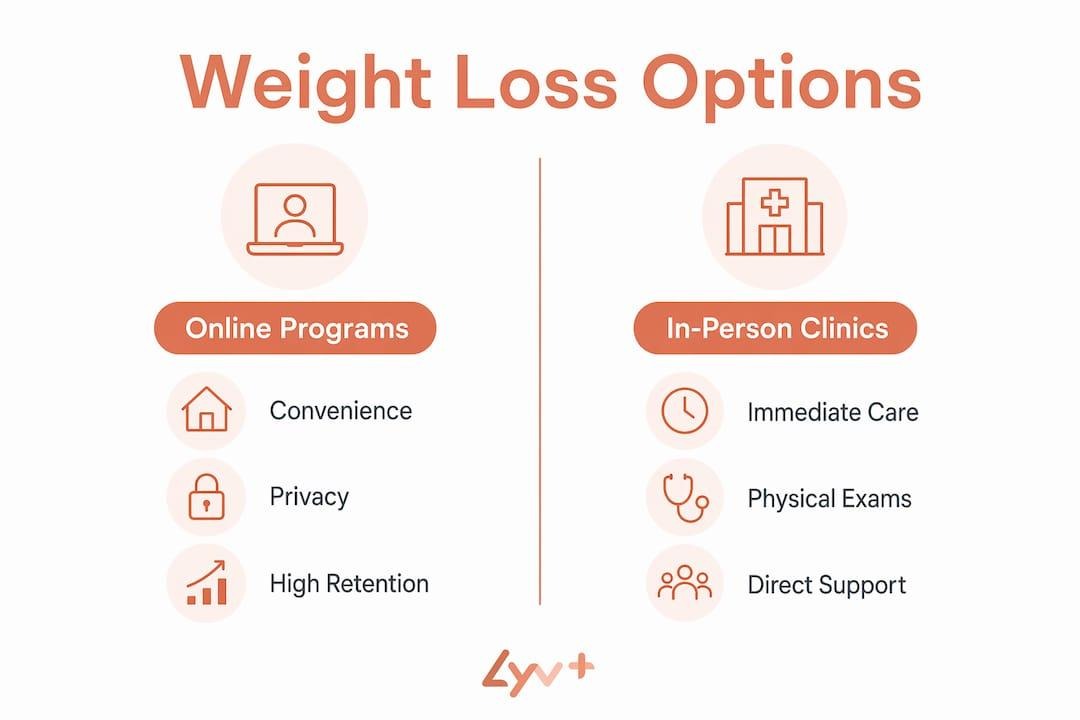
The in-person benefits are most pronounced for patients who need physical examinations, immediate clinical intervention, or on-site diagnostics. For the majority of medically stable adults, those advantages rarely come into play during routine weight loss follow-ups.
Online programmes remove what researchers call “friction.” Less friction means fewer missed appointments, more consistent engagement, and better adherence over time. Online coaching removes barriers that cause people to disengage, which is one reason retention rates tend to be higher in virtual cohorts.
Privacy is another consideration. Some people find it easier to discuss weight, eating habits, and emotional triggers from their own home rather than a clinical waiting room. That comfort can translate into more honest conversations and better care.
Pro Tip:Be honest with yourself about your technology comfort level. A poor video connection or an unfamiliar patient portal will frustrate you quickly. Most reputable online providers offer a short onboarding call to test the setup before your first clinical appointment.
Choosing the right format is less about preference and more about matching the model to your medical situation and lifestyle.
The physical activity increase of 575 MET-minutes per week in the virtual group is particularly striking. This is not a marginal difference. It suggests that removing logistical barriers does not just improve appointment attendance. It appears to support broader lifestyle changes as well.
Retention is where the gap is most significant. An 81% retention rate versus 51% means that online participants were far more likely to complete the programme. Dropping out early is one of the strongest predictors of poor weight loss outcomes, so this difference has real clinical weight.
One limitation worth noting is that online programmes rely on self-reported measurements for weight and activity. Verified data from in-person weigh-ins provides a more objective record. Some online providers address this by integrating with connected scales or wearable devices, which improves data accuracy without requiring a clinic visit.
The key success factor across both formats is frequent, high-quality feedback. When an online programme is designed with regular check-ins, digital self-monitoring, and consistent provider access, it matches or exceeds in-person results. When it is not, outcomes suffer regardless of the medication prescribed.
GLP-1 medications like semaglutide require careful medical oversight, and that oversight can be maintained effectively in both settings provided proper evaluation and follow-up are in place.
I have seen people tie themselves in knots trying to decide between online and in-person care, as if one is inherently more serious or more legitimate than the other. That framing is not helpful. What matters is whether the programme you choose includes genuine medical oversight, consistent provider access, and a treatment plan built around your specific situation.
The hybrid model is the approach I find most sensible for the majority of people. Start with a proper baseline assessment, ideally in person or through a thorough clinical review, then move to virtual follow-ups. You get the safety of a verified starting point without the ongoing friction of clinic visits every six weeks.
What I would caution against is choosing a programme based on price alone. A subscription that skips proper clinical assessment to keep costs low is not a bargain. It is a risk. The same applies to in-person clinics that charge premium rates but rotate you through different clinicians at every visit.
If you are considering clinician-guided weight loss and wondering whether online care is “real” care, the answer is yes, when it is done properly. The format is not the measure of quality. The clinical rigour behind it is.
— Lyv
If you are ready to explore a medically supervised online programme, Lyvpharmacy offers clinician-led assessments and access to prescription GLP-1 treatments including semaglutide, all from home.
Every patient goes through a proper clinical review before any prescription is issued. There are no shortcuts on safety. Lyvpharmacy combines fast, discreet access with genuine medical oversight, so you get the convenience of an online programme without compromising on clinical standards. Browse Lyvpharmacy’s weight loss treatments to see which options are available to you and take the first step with a team that takes your health seriously.
Both online and in-person weight loss programmes achieve comparable results when medically supervised, with virtual formats showing higher retention and greater physical activity gains in recent studies.
Point - Details
Outcomes are comparable
Virtual groups lost more weight on average and retained 81% of participants versus 51% in-person.
Format affects logistics, not quality
The clinical rigour of the programme matters more than whether it is delivered online or face-to-face.
Hybrid care is often best
An initial in-person assessment followed by virtual follow-ups balances safety with convenience.
Most people suit online care
Medically stable adults with busy schedules or limited local access are strong candidates for virtual programmes.
Accountability style matters
Around 1 in 10 people need in-person friction to stay consistent; knowing which group you belong to helps you choose wisely.
Recommended



.jpg)