Registered Pharmacy100% OnlineNew here? Use code: WELCOME10 for 10% OFFFree Shipping Over £50Fully Inspected & Regulated ServicesApproved UK-licensed TreatmentsRegistered Pharmacy100% OnlineNew here? Use code: WELCOME10 for 10% OFFFree Shipping Over £50Fully Inspected & Regulated ServicesApproved UK-licensed Treatments
19 Sep 2026

10min read
Contents

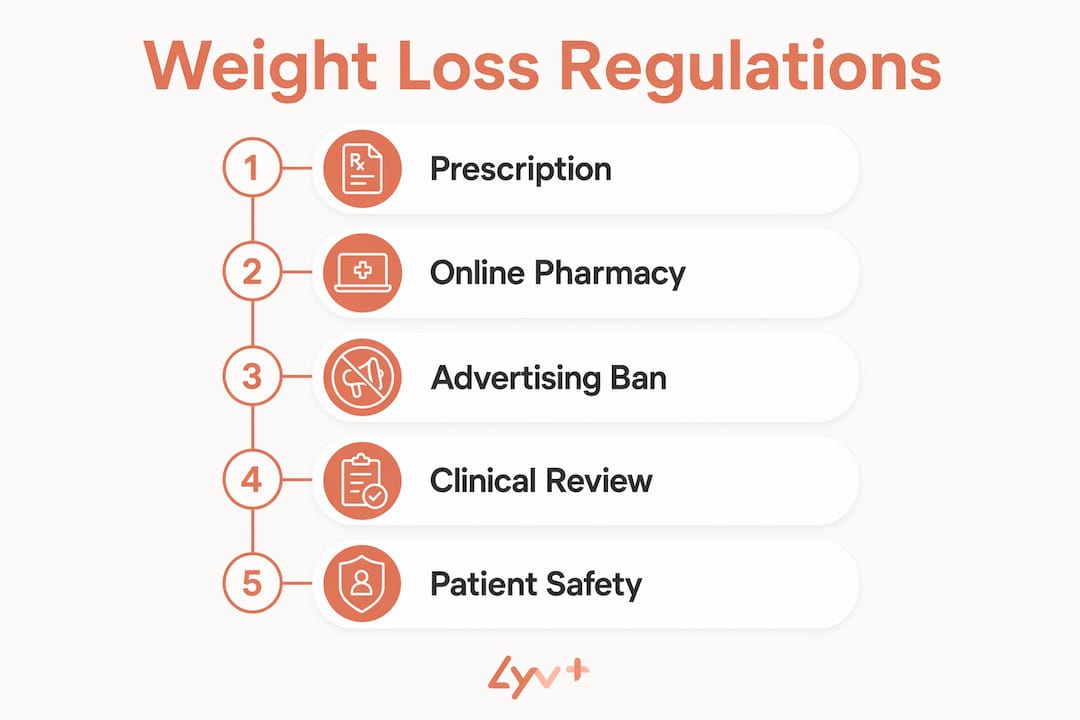
UK weight loss regulations define weight management medicines as prescription-only medicines (POMs), meaning no pharmacy or online provider can legally supply them without a valid prescription from an authorised clinician. The regulatory framework governing these treatments involves three key bodies: the Medicines and Healthcare products Regulatory Agency (MHRA), the General Pharmaceutical Council (GPhC), and the Advertising Standards Authority (ASA). Together, they set the rules for how weight loss medicines are licensed, prescribed, and promoted. Understanding what are UK weight loss regulations matters because the rules protect you from unsafe products, unqualified providers, and misleading advertising.
UK weight loss regulations are the legal standards that control how weight management medicines are licensed, prescribed, supplied, and advertised. The MHRA is the primary licensing authority. It decides which medicines receive market authorisation and under what conditions they can be used. The GPhC regulates pharmacies and pharmacy professionals, setting inspection standards for both physical and online providers. The ASA enforces advertising rules, working alongside the Committee of Advertising Practice (CAP) Code.
The classification of weight loss medicines as POMs is the foundation of the entire framework. A POM cannot be sold over the counter, ordered online without a prescription, or advertised directly to the public. This classification exists because these medicines carry real clinical risks and require medical supervision to be used safely. The rules apply equally to high-street pharmacies and online providers.

Regulation in this area has tightened considerably in 2026. The GPhC updated its inspection framework to address the rapid growth of online weight loss services, and the MHRA issued formal warnings to providers promoting unlicensed or newly licensed weight loss medicines without proper authorisation. These updates reflect how seriously regulators take patient safety in this space.
GLP-1 receptor agonists are the most prominent class of regulated weight loss medicines in the UK. These include semaglutide, the active ingredient in Wegovy, and tirzepatide, the active ingredient in Mounjaro. Both are prescription-only treatments licensed for specific medical indications, not for cosmetic weight loss. The MHRA sets the licensed indications, which typically require a patient to meet defined BMI thresholds and have associated health conditions such as type 2 diabetes or cardiovascular risk factors.
In 2026, the MHRA approved the first oral GLP-1 medicine for weight loss in the UK. Semaglutide tablets require a prescription and must be taken alongside dietary and physical activity guidance. This approval expanded treatment options but did not change the prescription-only status of the medicine. It remains subject to the same clinical oversight requirements as injectable GLP-1 treatments.
GLP-1 medicines are licensed for obesity or diabetes treatment, not cosmetic weight loss. Using them outside their licensed indications carries serious health risks and is not supported by the regulatory framework. Any provider offering these medicines for purely aesthetic purposes is operating outside the law.
Pro Tip: Before starting any weight loss medicine, check that the product has a UK marketing authorisation number. You can verify this on the MHRA's public register at gov.uk.
Online pharmacies face the same clinical and safety standards as face-to-face services. The GPhC makes this explicit: online providers must meet identical clinical safety and identity verification standards as in-person consultations. This means a provider cannot rely on a patient filling in a self-reported questionnaire and clicking "submit." Independent verification of clinical data is mandatory.
The GPhC's updated inspection framework identifies several non-negotiable requirements for online weight loss services:
Providers that fail these standards face formal GPhC intervention, which can include improvement notices, conditions placed on their registration, or suspension. The consequences are serious, and regulators have shown willingness to act quickly when patient safety is at risk.
Pro Tip: When choosing an online weight loss provider, look for a GPhC registration number displayed on their website. You can check any UK pharmacy's registration status at pharmacyregulation.org.
Advertising prescription-only weight loss medicines to the public is illegal in the UK. Rule 12.12 of the CAP Code prohibits the direct or indirect promotion of POMs to consumers. This rule applies to websites, social media, email marketing, and any other public-facing channel. The restriction covers both named medicines and terms that effectively promote them.
The MHRA and ASA have taken enforcement action against providers who used terms like "weight loss injections" or referenced specific GLP-1 drug names in their advertising. In may 2026, regulatory investigations led providers to remove medicinal product references from their websites to avoid breaching indirect advertising rules. The principle is straightforward: if a term creates public demand for a specific prescription medicine, it is likely to breach the rules.
Compliant providers follow a clear approach to advertising:
Even indirect promotion of POMs via terms that encourage public demand is prohibited. This means a provider cannot use a celebrity endorsement, a before-and-after image, or a social media post that implies a specific medicine is available without a prescription. Regulators treat these as advertising breaches regardless of whether the medicine is named explicitly.
Knowing the rules helps you make better decisions when seeking weight loss treatment. The regulatory framework exists to protect you, and understanding it means you can spot providers who are not operating within it. Here is what to look for and what to avoid.
Choosing a compliant provider
Understanding the prescription process
The UK prescription process for weight loss medicines requires a clinician to assess your medical history, current health status, BMI, and any contraindications before issuing a prescription. This is not a formality. It is a clinical decision with legal and safety implications. Providers who skip this step are not just cutting corners; they are breaking the law.
Red flags to avoid
Compliance alone is not enough. The best providers go beyond the minimum, offering transparent clinical reviews, detailed documentation, and genuine ongoing support. You deserve that standard of care, and the regulations are designed to make it the baseline.
UK weight loss regulations classify all weight management medicines as prescription-only, requiring independent clinical assessment, licensed indications, and strict advertising compliance from every provider operating in this space.
Point - Details
POMs require a prescription
No weight loss medicine can be legally supplied without a valid prescription from an authorised clinician.
Independent verification is mandatory
Providers must verify BMI and health data independently; self-reported forms alone do not meet GPhC standards.
Advertising POMs to the public is illegal
Naming specific medicines or using terms like "weight loss injections" in consumer ads breaches CAP Code Rule 12.12.
GLP-1 medicines have licensed indications
Semaglutide and tirzepatide are approved for obesity or diabetes, not cosmetic weight loss.
Check provider credentials before committing
A GPhC registration number and named prescriber are the minimum signs of a compliant service.
I have seen the weight loss medicine market change dramatically in a short period of time. The speed at which GLP-1 treatments became household names created an environment where demand outpaced regulation, and some providers exploited that gap. The consequences for patients were real: incorrect dosing, no clinical follow-up, and in some cases, medicines that were not what they claimed to be.
What strikes me most is how often people underestimate the risk of going outside the regulated system. The appeal of a cheaper, faster, no-questions-asked option is understandable. But the clinical assessment is not bureaucracy. It is the step that catches contraindications, identifies mental health vulnerabilities, and ensures the medicine is appropriate for you specifically. Skipping it is not a shortcut. It is a gamble with your health.
The 2026 regulatory updates from the GPhC and MHRA are a direct response to what happened when oversight was insufficient. They are not perfect, but they represent a genuine effort to raise the floor for patient safety across the board. My view is that these updates do not go far enough on enforcement speed, but the direction is right.
If you are considering a clinician-led weight management service, the regulations give you a clear checklist. Use it. A provider that welcomes scrutiny and makes its clinical processes transparent is the one worth trusting.
— Lyv
Lyvpharmacy operates within the full scope of UK weight loss regulations, holding GPhC registration and conducting independent clinical assessments for every patient before any prescription is issued.

Every assessment at Lyvpharmacy goes beyond a basic BMI check. Clinicians review your full health history, screen for contraindications, and confirm clinical suitability before prescribing GLP-1 treatments such as Wegovy or Mounjaro. Prescriptions are issued by named, qualified clinicians, and ongoing support is built into the process. If you want to understand how to qualify for weight loss medication under UK guidelines, Lyvpharmacy's clinical team can walk you through the criteria clearly and without pressure. Explore Lyvpharmacy's regulated weight loss treatments to find out what is available and whether you may be eligible.




.jpg)