Registered Pharmacy100% OnlineNew here? Use code: WELCOME10 for 10% OFFFree Shipping Over £50Fully Inspected & Regulated ServicesApproved UK-licensed TreatmentsRegistered Pharmacy100% OnlineNew here? Use code: WELCOME10 for 10% OFFFree Shipping Over £50Fully Inspected & Regulated ServicesApproved UK-licensed Treatments
18 Sep 2026

9min read
Contents

Trust is the single most important factor determining whether a weight loss service works for you. Without it, patients disengage, skip doses, and abandon treatment before results arrive. The role of trust in weight loss services extends far beyond feeling comfortable with a clinician. It shapes whether you believe the treatment will work, whether you follow through, and whether you feel safe enough to be honest about your struggles. GP Terry Kemple describes trust as the "glue" of effective healthcare communication. When that glue is missing, even the most clinically sound treatment plan falls apart.
Trust directly improves how consistently patients follow their treatment plans. When you believe in the competence and intentions of your provider, you are far more likely to take medication correctly, attend follow-up appointments, and report side effects honestly. That openness creates a feedback loop where clinicians can adjust doses, offer reassurance, and prevent early dropout.

The consequences of low trust are measurable. High discontinuation rates among GLP-1 users are closely linked to insufficient clinical support and a reliance on social media for guidance rather than healthcare professionals. Patients who feel unsupported do not just stop a treatment. They often regain weight rapidly and lose confidence in seeking help again.
The importance of trust in dieting also shows up in how patients frame their own behaviour. When you trust your provider, you are more likely to view setbacks as manageable rather than catastrophic. That shift in mindset is what separates short-term attempts from lasting change.
Pro Tip: If your provider does not offer a structured follow-up pathway after prescribing, ask directly how dose adjustments and side effects will be managed. A good provider will have a clear answer.
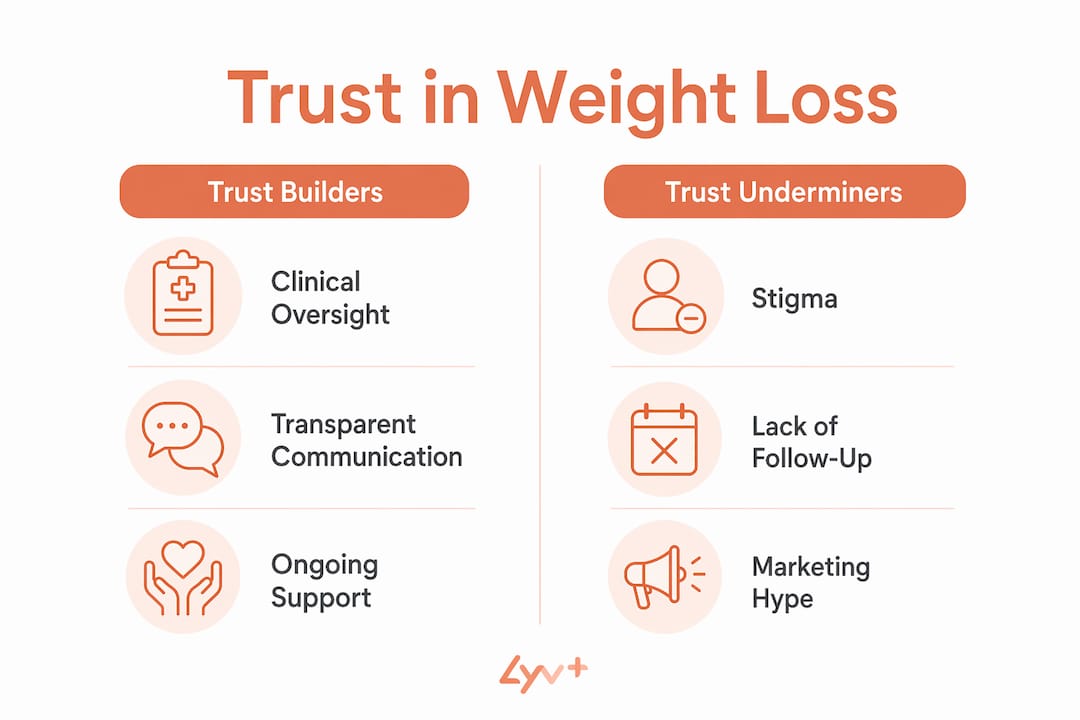
Social stigma is one of the most underestimated barriers to effective weight management. Two-thirds of GLP-1 users in the UK conceal their treatment from friends and family. That figure reflects a culture where weight loss medication is still viewed with suspicion, even as clinical evidence for its effectiveness continues to grow.
The judgements people face are specific and damaging. 79% of GLP-1 users report being accused of taking the "easy way out," and 68% are told simply to eat less and move more. These responses are not just unhelpful. They actively erode a patient's trust in their own treatment decision, which in turn reduces adherence.
"When patients feel judged for their treatment choices, they stop talking about them. And when they stop talking, they stop getting the support they need. Secrecy and stigma do not just affect confidence. They affect clinical outcomes."
Younger adults and women are disproportionately affected by this stigma and concealment. The gap between public perception and clinical evidence is wide. Pharmacological treatments are still perceived by many as less legitimate than surgery or diet-based approaches, despite comparable or superior evidence for certain populations. That perception gap is a trust gap, and it has real consequences for who seeks help and who does not.
Without evidence-led messaging and professional oversight, patients delay care or manage treatment alone. Isolation from clinical guidance harms both adherence and outcomes. The trustworthiness of weight loss programmes depends partly on how well they equip patients to handle social pressure, not just physical side effects.
A trustworthy weight loss provider delivers four things without exception: an initial medical consultation, a clear prescribing pathway, secure medication supply, and structured follow-up for dose adjustments and side effects. Providers that omit clinical reviews or follow-up represent a lower standard of care and a higher risk to patients. That is not a matter of preference. It is a matter of safety.
Patients struggle to differentiate between providers based on marketing alone. The real differentiators are the delivery model, the accessibility of clinicians, and the quality of ongoing support. Surface-level branding tells you very little. The clinical pathway tells you everything.
Pro Tip: Check whether a provider lists their prescribing clinicians by name and registration number. Transparency about who is responsible for your care is a basic standard, not a bonus feature.
Providers offering only prescription and medication supply without ongoing clinical support are delivering below-standard care. The trust factors in diet services that matter most are not the ones visible in advertising. They are the ones that show up when something goes wrong, when a dose needs adjusting, or when a patient needs reassurance at week six.
Building trust with weight loss coaches and clinicians is an active process, not a passive one. The quality of that relationship directly affects your motivation, your willingness to be honest, and your ability to sustain behavioural change over time. Here is what that process looks like in practice.
The clinician-guided approach to weight loss is built on exactly this kind of relationship. Clear communication, expert oversight, and personalised care are not extras. They are the foundation of any treatment that actually works.
Trust is the defining factor in weight loss treatment adherence, and providers who lack clinical oversight, transparency, and follow-up pathways consistently produce worse outcomes.
Point - Details
Trust drives adherence
Patients who trust their provider follow treatment plans more consistently and report side effects honestly.
Stigma reduces outcomes
66% of GLP-1 users in the UK conceal treatment, which isolates them from clinical support and harms adherence.
Four pillars of a trustworthy provider
Look for consultation, prescribing accountability, secure supply, and structured follow-up as non-negotiable standards.
Social media is not a substitute
Relying on social media for clinical guidance fuels misconceptions and reduces trust in evidence-based treatment.
Continuity builds confidence
Seeing the same clinician repeatedly improves communication quality and long-term treatment success.
The patients who struggle most are rarely those with the hardest biology. They are the ones who never felt safe enough to be honest with their provider. I have seen people quietly stop taking medication because they were embarrassed to report a side effect, or because they feared being judged for not losing weight fast enough. That silence is not a personal failing. It is what happens when the clinical relationship does not create enough trust to hold it.
The evidence is clear. 93% of patients trust their GP after a visit, but that trust is fragile and context-dependent. Weight loss sits at the intersection of medicine, identity, and social judgement. That makes it uniquely vulnerable to trust breakdown. A provider who treats weight loss as a purely pharmacological problem misses the point entirely.
My honest view is that the biggest gap in UK weight loss services is not access to medication. It is the absence of consistent, non-judgmental clinical relationships. Prescription without support is not a service. It is a transaction. And transactions do not change behaviour.
If you are choosing a provider, advocate for yourself. Ask who will be responsible for your care. Ask what happens if the medication does not suit you. Ask how they handle patients who are not progressing. The answers will tell you more than any marketing claim ever could.
— Lyv
Lyvpharmacy is built around the principle that safe weight loss requires more than a prescription. Every patient goes through a structured clinical assessment before treatment begins, with a named prescriber accountable for their care throughout.
Treatments including Wegovy and Mounjaro are available through a pathway that includes initial consultation, secure supply, and ongoing follow-up for dose adjustments and side effects. There is no guesswork about who is responsible for your care. Lyvpharmacy's clinician-guided weight loss treatments are designed for people who want medically sound results, not shortcuts. If you are ready to work with a provider that takes your safety and progress seriously, Lyvpharmacy is the place to start.



.jpg)