Registered Pharmacy100% OnlineNew here? Use code: WELCOME10 for 10% OFFFree Shipping Over £50Fully Inspected & Regulated ServicesApproved UK-licensed TreatmentsRegistered Pharmacy100% OnlineNew here? Use code: WELCOME10 for 10% OFFFree Shipping Over £50Fully Inspected & Regulated ServicesApproved UK-licensed Treatments
07 May 2026

9min read
Contents
Author

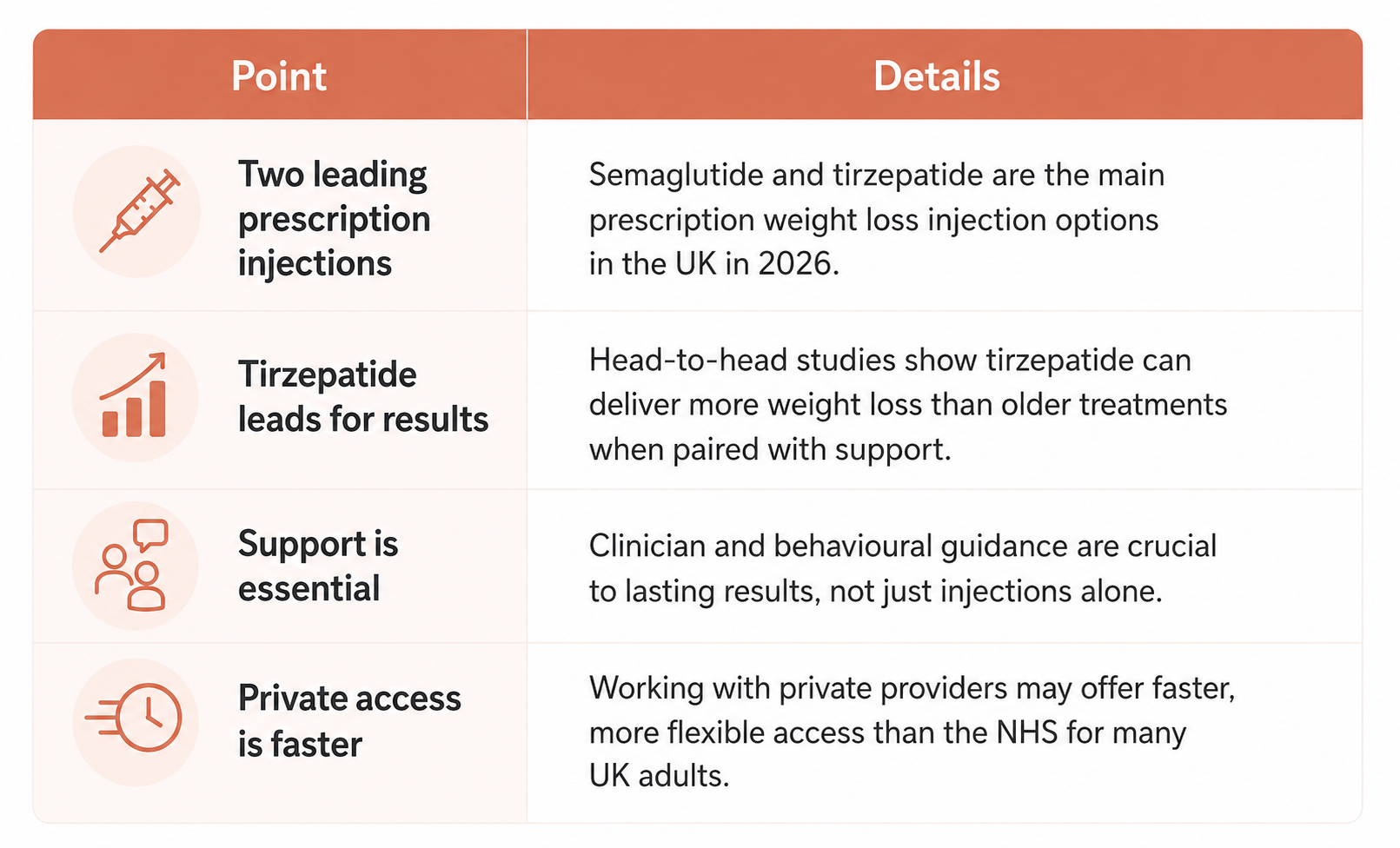
Choosing the right prescription weight loss treatment in 2026 has never felt more urgent, or more confusing. New clinical data is arriving fast, NHS waiting lists remain long, and the options on the market have genuinely expanded. Whether you have been researching for months or are only just starting, you deserve a clear, evidence-based breakdown of what actually works, what the science says, and how to access effective treatment without unnecessary delay. This article gives you exactly that: a straightforward comparison of the leading prescription injections available to UK adults right now, grounded in real clinical evidence.
Not all weight loss treatments are equal. Before you compare individual options, it helps to understand the criteria that separate genuinely effective treatments from those that simply sound promising.
Regulatory approval and clinical evidence are your first filter. A treatment backed by NICE guidance and NHS-approved trial data carries far more weight than one supported only by marketing claims. In the UK, weight loss treatments online must meet strict regulatory standards before they can be prescribed, and that matters enormously for your safety.
Effectiveness in real-world conditions is equally important. Clinical trials are controlled environments. The question is whether results translate when people are living ordinary lives, managing stress, work, and family alongside treatment. Look for trials with large sample sizes, long follow-up periods, and outcomes that measure sustained weight loss rather than short-term drops.
Lifestyle and behavioural support is not optional. This is a point that often gets glossed over. NHS/NICE guidance confirms that the main established prescription injectable options, including semaglutide (Wegovy) and tirzepatide (Mounjaro), are recommended alongside lifestyle and behavioural support. Understanding why crash diets fail makes it clear why medication alone is rarely a complete answer.
Here is what to look for when evaluating any prescription weight loss treatment:
Pro Tip: When comparing providers, ask specifically what happens after your first prescription. A provider that offers repeat assessments, dose adjustments, and check-ins is far more likely to support lasting results than one that simply sends out medication.
Now that you know what to look for, let’s examine the leading options individually.
Semaglutide, sold under the brand name Wegovy, is a GLP-1 receptor agonist. In plain terms, it mimics a hormone your body naturally produces after eating, one that signals fullness to your brain and slows gastric emptying. The result is that you feel satisfied with less food, and cravings become significantly easier to manage.

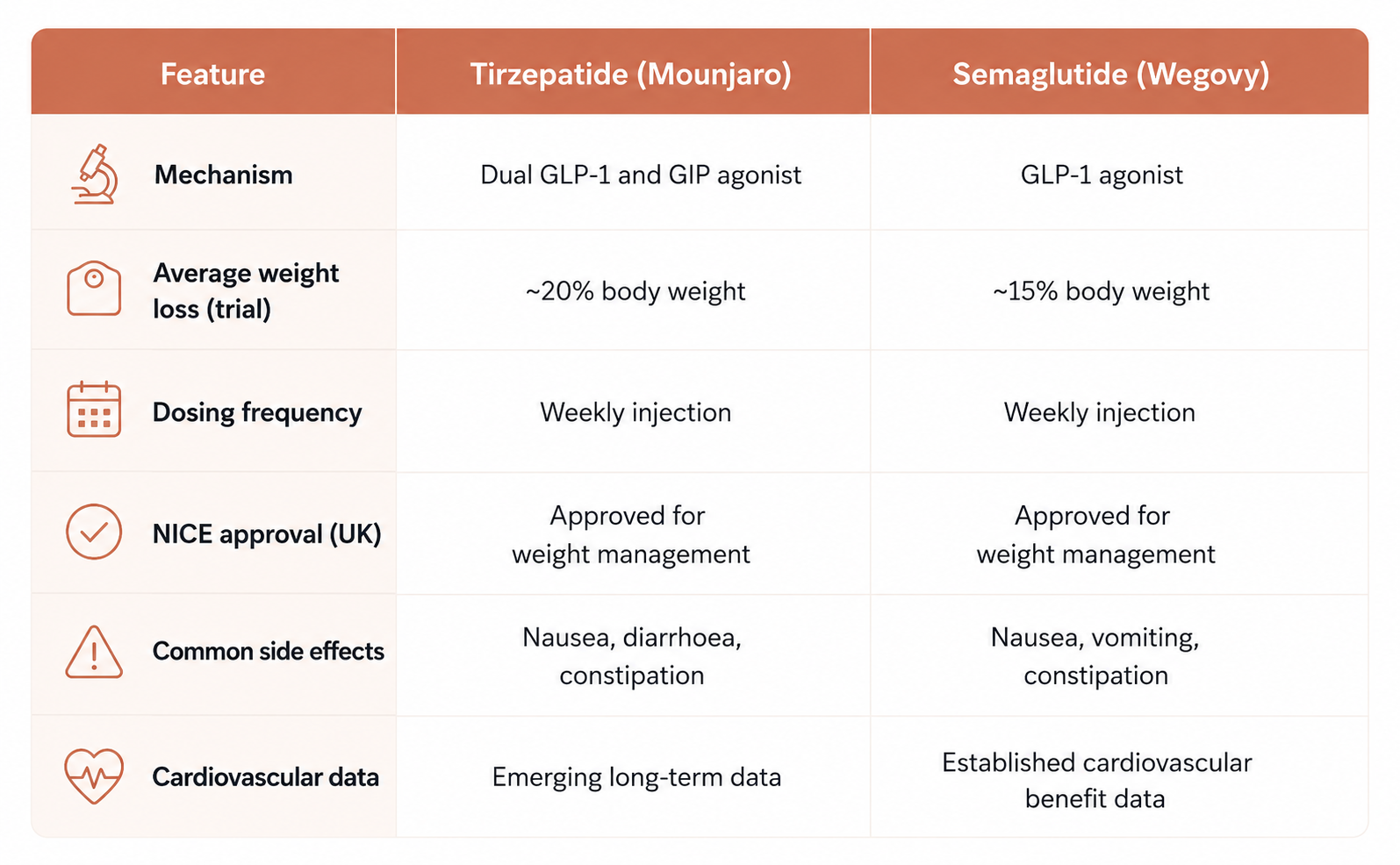
The clinical evidence behind semaglutide is substantial. NHS/NICE guidance includes it as one of the main established prescription injectable options for specialist weight management services in the UK. The STEP trials, which formed the basis for its approval, showed average weight loss of around 15% of body weight over 68 weeks when combined with lifestyle support.
Key advantages of semaglutide:
Considerations to be aware of:
“Think of semaglutide as giving your appetite regulation system a reset. It does not remove the need for healthy habits, but it makes those habits far easier to maintain.”
For a deeper understanding of how this medication category works, the GLP-1 medications overview is worth reading before you start.
Pro Tip: Nausea during the first few weeks of semaglutide is common but manageable. Eating smaller meals, avoiding fatty or spicy foods, and staying well-hydrated can make the adjustment period much more comfortable.
After semaglutide, it is crucial to consider the new leader: tirzepatide.
Tirzepatide, branded as Mounjaro, represents a genuine step forward in prescription weight management. Unlike semaglutide, which targets only the GLP-1 receptor, tirzepatide has a dual-action mechanism. It activates both GLP-1 and GIP (glucose-dependent insulinotropic polypeptide) receptors simultaneously. This dual approach appears to produce stronger appetite suppression and greater metabolic effects than single-receptor treatments.
The headline trial data is striking. Head-to-head evidence from SURMOUNT-5 published in the New England Journal of Medicine shows that tirzepatide produced greater weight loss than semaglutide in adults with obesity over 72 weeks. Participants using tirzepatide lost an average of approximately 20% of their body weight, compared to around 14% with semaglutide. That is a meaningful clinical difference.
Key strengths of tirzepatide:
Points to consider:
The GLP-1 clinical evidence page provides a fuller breakdown of how both receptor pathways contribute to weight loss if you want to understand the science behind these numbers.
Statistic to note: In SURMOUNT-5, tirzepatide users also saw significantly greater reductions in waist circumference, a key marker of metabolic health risk, compared to those using semaglutide over the same period.
All the above options work best when combined with supportive interventions. This is not a caveat. It is a clinical requirement.
Medication alone rarely produces lasting results. The biology is clear: GLP-1 treatments suppress appetite and support weight loss while you are taking them. But without changes to eating patterns, activity levels, and the psychological relationship with food, the underlying habits that contributed to weight gain remain unchanged.
WHO’s 2025 global guideline frames GLP-1 therapies as part of a comprehensive, chronic and relapsing approach to obesity management. Importantly, WHO issues conditional rather than unconditional recommendations, reflecting factors including limited long-term data, costs, and health system readiness. This is not a reason to avoid treatment. It is a reason to choose a provider who takes the full picture seriously.
“GLP-1 medicines are a significant tool, but they work best as part of a broader, supported plan. The medication opens the door. Behavioural support helps you walk through it.”
What meaningful behavioural support looks like for UK adults:
Clinician-guided weight loss is not just about having a doctor sign a prescription. It means having ongoing support that adapts as your needs change. That is the standard you should expect from any provider you choose.
Why this matters practically:
Most articles about prescription weight loss injections focus on the numbers: how much weight you can lose, how quickly, and which medication wins the head-to-head comparison. That is useful. But it misses something important.
WHO’s conditional recommendations exist precisely because even the strongest clinical evidence leaves open questions about what happens after treatment ends, beyond the trial horizon, and across diverse populations. That is not a reason for pessimism. It is a reason to choose your provider carefully and to treat the medication period as a foundation, not a finish line.
What we see consistently is that people who do best are those who use the appetite suppression window to genuinely build new patterns. Not perfection, but progress. The science-based weight loss evidence is clear: sustainable change comes from consistent, supported behaviour shifts, not from white-knuckling through restriction.
Ongoing support should be a deal-breaker when you choose a provider. If a service offers a prescription without follow-up, that is a gap worth taking seriously.
If you are ready to move from research to action, the good news is that you do not have to wait for NHS delays to begin effective, clinician-supported treatment.

At LYV Pharmacy, we offer fast access to weight loss treatments UK including Wegovy and Mounjaro through a fully regulated, clinician-led process. From your initial assessment to your first delivery, everything is designed to be straightforward, discreet, and medically sound. Our team reviews your health profile carefully and supports you throughout treatment, not just at the start. If you want to understand the full clinical picture before you begin, our GLP-1 truth guide is a good place to start.