Registered Pharmacy100% OnlineNew here? Use code: WELCOME10 for 10% OFFFree Shipping Over £50Fully Inspected & Regulated ServicesApproved UK-licensed TreatmentsRegistered Pharmacy100% OnlineNew here? Use code: WELCOME10 for 10% OFFFree Shipping Over £50Fully Inspected & Regulated ServicesApproved UK-licensed Treatments
01 Aug 2026

9min read
Contents

The NHS is defined as the primary gateway to clinical weight loss support for eligible adults in the UK, offering structured programmes, prescribed medications, and specialist services under NICE guidelines. Despite this framework, only 1% of eligible patients currently access NHS weight loss services. That figure reveals a significant gap between policy and practice. Understanding the role of NHS in weight loss access means understanding both what is available and why so many people cannot yet reach it. This guide covers the programmes, medications, eligibility thresholds, and practical steps you can take right now.
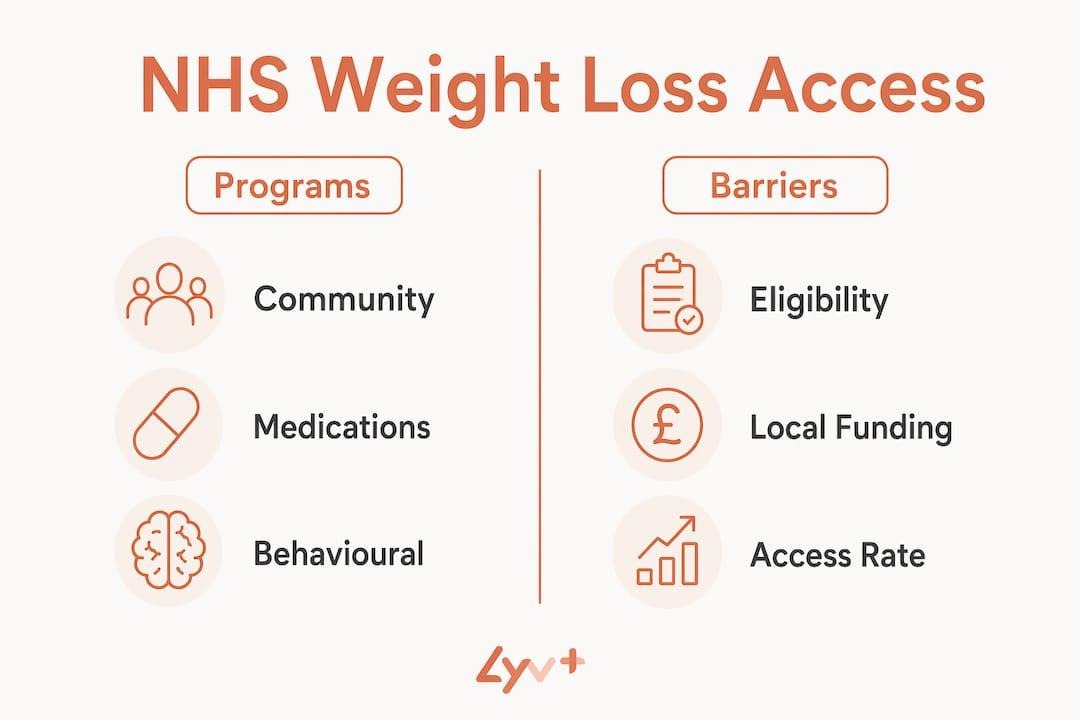
The NHS provides weight loss support through three main routes: community weight management programmes, prescribed medications, and specialist multidisciplinary clinics. Access to each route depends on clinical eligibility, local commissioning, and whether your Integrated Care Board (ICB) has funded the relevant service. NHS England sets the national direction, NICE guidelines define the clinical thresholds, and ICBs decide what is actually available in your area. This three-layer structure is where most of the complexity and frustration originates.

The NHS’s role is not simply to hand out prescriptions. It is to deliver weight management services within a framework that links medication to behavioural support, clinical review, and long-term follow-up. That approach is clinically sound. The challenge is that the infrastructure to deliver it consistently across England does not yet exist at scale.
NHS weight loss programmes range from digital tools to face-to-face specialist clinics. The type of support you can access depends largely on your BMI, existing health conditions, and what your local ICB has commissioned.
The main options currently available include:
The behavioural component is not optional. NHS England requires that medication prescriptions are paired with structured lifestyle support, which means attending sessions, engaging with dietary guidance, and committing to physical activity goals alongside any medication you are prescribed.
Pro Tip:If you are unsure which tier of service applies to you, ask your GP to clarify which locally commissioned pathways exist in your ICB area before your appointment. This saves time and sets realistic expectations.
The NHS prescribes several weight loss medications under NICE-approved criteria. Eligibility is not based on weight alone. It requires a specific BMI threshold combined with clinical risk factors.
Medication - Active ingredient - NHS eligibility (general)
Mounjaro - Tirzepatide - BMI ≥35 with comorbidities, or BMI ≥40
Wegovy - Semaglutide - BMI ≥35 with comorbidities, or BMI ≥40
Saxenda - Liraglutide - BMI ≥35 with comorbidities, or BMI ≥40
Eligibility thresholds are adjusted for ethnicity. Adults from South Asian, Chinese, Black African, or Black Caribbean backgrounds may qualify at a BMI of 27.5 with comorbidities, or 32.5 without. This adjustment reflects the higher cardiometabolic risk at lower BMI levels in these populations.
Mounjaro (tirzepatide) is the most recently introduced medication at scale. The NHS began a 12-year phased roll-out starting in january 2026, with a target of reaching 220,000 patients in the first three years. That is a meaningful commitment, but it also means access will be gradual and prioritised by clinical need. You can read more about how Wegovy and Mounjaro compare if you are trying to understand which treatment might be relevant to your situation.
All three medications are GLP-1 receptor agonists or dual agonists that reduce appetite and slow gastric emptying. They are clinically proven to support significant weight loss when used correctly. The NHS mandates that any prescription is paired with wraparound care, meaning you must participate in a structured behavioural support programme alongside the medication.
Pro Tip:If you believe you meet the BMI and comorbidity criteria, ask your GP specifically whether your ICB has commissioned a funded pathway for tirzepatide or semaglutide. Without a commissioned pathway, your GP may not be able to prescribe even if you are clinically eligible.
Access to NHS weight loss support is not equal across England. Where you live determines what you can access, often more than your clinical need does.
The core barriers are:
“People are being told they qualify for treatment, but there is no local service to refer them to. That is not a clinical failure. It is a commissioning failure.” This reflects the experience reported by GPs and patient advocates across England in 2026.
The result is that only 1% of eligible patients currently access NHS weight loss services. For a condition that affects millions of adults and carries serious health consequences, that figure is striking. It means the system’s intent and its delivery are still far apart.
Knowing how the system works gives you a real advantage when navigating it. The process is not always straightforward, but there are concrete steps you can take.
The NHS provides structured weight loss support, but access depends heavily on local commissioning, eligibility criteria, and whether your ICB has funded the relevant pathway.
Point - Details
NHS access is limited
Only 1% of eligible patients currently access NHS weight loss services, despite widespread need.
Eligibility requires BMI thresholds
General criteria are BMI ≥40, or BMI ≥35 with comorbidities, with lower thresholds for some ethnic groups.
Wraparound care is mandatory
NHS medication prescriptions require participation in a structured behavioural support programme.
Postcode lottery is real
ICB commissioning decisions create significant regional variation in service and medication availability.
Pharmacies may widen access
Community pharmacies are proposed as the most effective route to expand equitable access nationally.
I have spent a lot of time looking at how the NHS weight loss system actually works in practice, not just in policy documents. What strikes me most is the gap between the clinical intent and the lived experience of patients trying to access support.
The NICE guidelines are well designed. The wraparound care model is clinically sound. The 12-year Mounjaro roll-out shows genuine ambition. But ambition at the national level does not help someone who lives in an ICB area that has not yet commissioned a funded pathway. That person is clinically eligible, motivated, and being told to wait for a system that may not reach them for years.
The pharmacy commissioning proposal is the most practical near-term solution I have seen. Pharmacies already support over a million patients monthly. They have the infrastructure, the clinical oversight, and the community presence to deliver weight management support at scale. If ICBs commission this properly, it could genuinely reduce the postcode lottery effect.
My honest view is this: if you are eligible and your local NHS pathway is not yet available, do not treat waiting as the only option. A regulated, clinician-guided service with proper medical oversight is not a workaround. It is a legitimate and safe path forward. The NHS system will catch up. But your health does not have to wait for it.
— Lyv
If you meet the clinical criteria for weight loss medication but your local NHS pathway is not yet commissioned, Lyvpharmacy offers a regulated alternative with full clinical oversight. Every patient goes through a thorough clinical assessment before any prescription is issued. There are no shortcuts and no compromises on safety.
Lyvpharmacy provides access to prescription weight loss treatments including GLP-1 medications, with discreet home delivery and ongoing clinical support built in. If you want to understand what clinician-guided weight loss actually means before you start, that resource is a good place to begin. Treatment is medically supervised, evidence-based, and designed for people who want real results.