Registered Pharmacy100% OnlineNew here? Use code: WELCOME10 for 10% OFFFree Shipping Over £50Fully Inspected & Regulated ServicesApproved UK-licensed TreatmentsRegistered Pharmacy100% OnlineNew here? Use code: WELCOME10 for 10% OFFFree Shipping Over £50Fully Inspected & Regulated ServicesApproved UK-licensed Treatments
24 Jul 2026

9min read
Contents

A repeat prescription is a formal authorisation from your GP that allows you to collect the same medication regularly without booking a new appointment each time. This repeat prescription process guide covers everything you need to know: who qualifies, how to request your medication, what happens behind the scenes, and how to avoid common delays. Whether you take medication for asthma, diabetes, or another long-term condition, understanding this process protects you from running out at the worst possible moment.
A repeat prescription is issued for patients with stable, long-term conditions who need the same medication on an ongoing basis. Repeat prescriptions make up approximately 75% of all prescriptions in UK general practice. That figure reflects just how central this system is to everyday healthcare in Britain.
Your GP authorises a repeat prescription after an initial consultation confirms your condition is stable and your medication is appropriate. That authorisation typically lasts 6–12 months, after which a clinical review is required before further supplies can be issued.
Common conditions covered by repeat prescriptions include:
You are not automatically entitled to a repeat prescription. Your GP must confirm that your condition is stable, your dosage is correct, and no safety concerns exist. Think of the authorisation as a renewable licence, not a permanent one.
The most important change in 2026 is that patient-led ordering is now standard across most UK GP practices. Pharmacies no longer request medications on your behalf. You are responsible for placing the order yourself, every time.

This shift prevents unnecessary delays and missed doses that occurred when pharmacy-initiated requests fell through the gaps. The practical implication is simple: if you do not order, you do not receive.
The main methods for requesting a repeat prescription are:
Telephone requests have largely been discontinued at most GP surgeries. This reduces errors and keeps phone lines free for urgent clinical calls. Do not rely on calling your surgery to place a repeat order.
Order at least 7 working days before you run out. GP processing alone takes 2–4 working days, and the pharmacy needs additional time to dispense and prepare your medication.
Pro Tip:Set up a nominated pharmacy through the NHS App. Your GP can send your prescription electronically to your chosen pharmacy, so you only need to turn up and collect. No paper, no waiting for a physical prescription to arrive.
The prescription journey involves multiple coordinated steps that most patients never see. Understanding them explains why the process takes several days and what can cause delays.
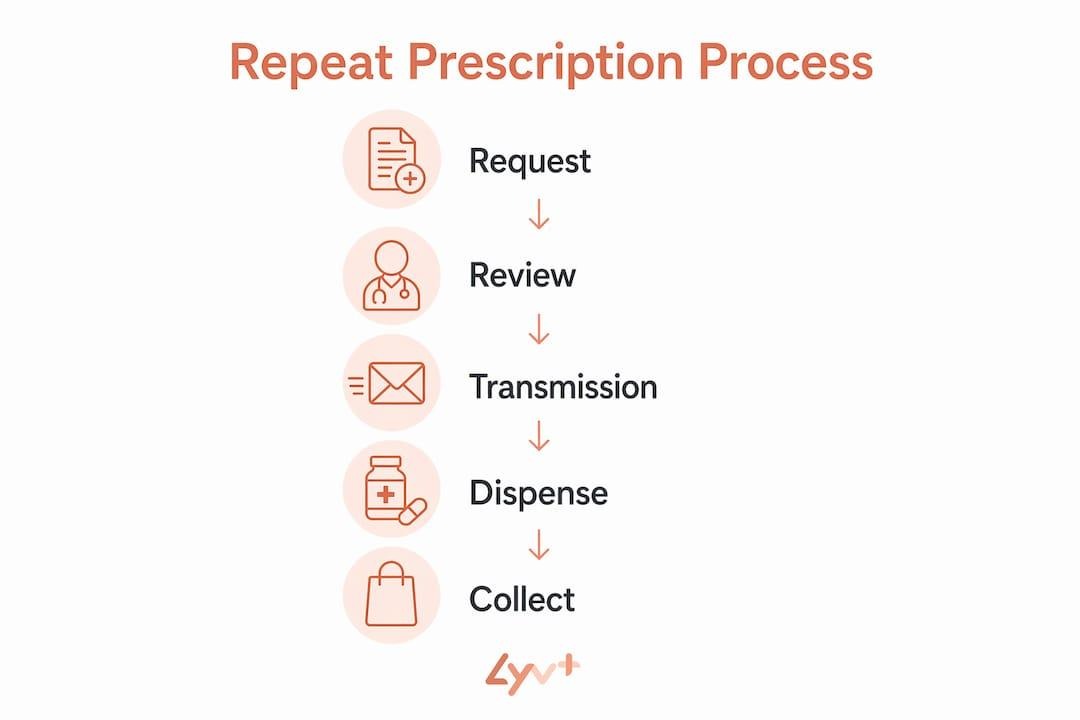
The Electronic Prescription Service (EPS) transmits your prescription securely via the NHS Spine the moment your GP signs it off. This means the delay is almost never in the transfer itself. The wait is in the clinical review at the surgery and the dispensing checks at the pharmacy.
Medication reviews are a required safety step, not an obstacle. If your GP withholds a prescription pending a review, it signals that a clinical check-up is due, not that something is wrong. Book that appointment promptly to avoid a longer gap in your supply.
Stock shortages at the pharmacy can also cause delays. If your medication is unavailable, your pharmacist can contact other local branches or suggest a clinically equivalent alternative with your GP’s approval.
Pro Tip:Check the UK prescription process in detail via the UK prescription process guide if you want a fuller picture of how authorisation and dispensing interact.
Electronic Repeat Dispensing (eRD) is a system where your GP issues a batch of prescriptions covering up to 12 months of medication in one go. You then collect each instalment from your pharmacy at regular intervals without contacting your GP surgery each time.
eRD suits patients whose conditions are very stable and whose medication has not changed in a long time. The key benefits include:
To access eRD, your GP must decide you are a suitable candidate. You cannot self-refer into the system. Eligibility is typically based on condition stability, consistent dosage, and a good history of attending medication reviews.
The limitation of eRD is that it requires your condition to remain unchanged. If your dosage is adjusted or your medication is switched, the existing eRD batch must be cancelled and reissued. Discuss eRD with your GP at your next medication review if you think it could work for you.
Patients with very stable conditions benefit greatly from eRD, as it reduces the administrative steps that can otherwise lead to missed doses.
Most delays in the repeat prescription process are preventable. The problems below come up regularly, and each has a straightforward solution.
“Repeat prescribing is for continuity of care, not permanent entitlement.” — AccessGP clinical guidance
Setting a recurring reminder on your phone two weeks before you expect to run out gives you enough buffer to order, wait for processing, and collect without stress. Treat it the same way you would a bill payment. It is a regular task, not an emergency.
Managing your repeat prescriptions well comes down to ordering early, using digital tools, and staying on top of medication reviews.
Point - Details
Order 7 working days early
Submit your request before you run out to allow time for GP review and pharmacy dispensing.
Use the NHS App
Digital ordering via the NHS App is the fastest method and lets you track your request in real time.
Patient-led ordering is now standard
Since april 2026, pharmacies no longer order on your behalf. You must place every request yourself.
Medication reviews are required
Authorisation lasts 6–12 months. A refused prescription usually means a review is due, not a permanent block.
eRD suits stable conditions
Electronic Repeat Dispensing covers up to 12 months and reduces the need for repeated GP contact.
The single biggest mistake I see patients make is treating their repeat prescription like a tap they can turn on at any moment. It is not. The system has real processing steps, real clinicians reviewing your records, and real stock constraints at pharmacies. Respecting that timeline is the difference between a smooth experience and a stressful scramble.
Digital tools have genuinely changed this for the better. The NHS App is not perfect, but it gives you visibility that simply did not exist before. Knowing your prescription is sitting with the GP, or has been sent to the pharmacy, removes a lot of anxiety. Use it.
The part most patients overlook is the medication review. I understand why. It feels like an obstacle when you just want your medication. But those reviews exist because your body and your condition change over time. A clinician checking in once or twice a year is not bureaucracy. It is the system working as it should.
If you are on a GLP-1 medication such as Wegovy or Mounjaro, the review process carries even more weight. Dosage adjustments are common, and your prescriber needs to confirm the treatment is still appropriate at each stage. Staying engaged with that process, rather than resenting it, leads to better outcomes.
Plan ahead, use the digital tools available, and see your medication review as a check-in rather than a hurdle. Future-you will be grateful.
— Lyv
Lyvpharmacy is a clinician-led online pharmacy built for patients who want fast, safe access to prescription treatments without the friction of traditional routes.
If you are managing a long-term condition and want a clearer path to your medication, Lyvpharmacy offers online consultations, clinical assessments, and discreet home delivery. The weight loss treatments available include GLP-1 medications such as Wegovy and Mounjaro, prescribed and overseen by registered clinicians. Every prescription is reviewed for safety before it is issued. You can also read about clinician-guided weight loss to understand what medical oversight actually means in practice.