Registered Pharmacy100% OnlineNew here? Use code: WELCOME10 for 10% OFFFree Shipping Over £50Fully Inspected & Regulated ServicesApproved UK-licensed TreatmentsRegistered Pharmacy100% OnlineNew here? Use code: WELCOME10 for 10% OFFFree Shipping Over £50Fully Inspected & Regulated ServicesApproved UK-licensed Treatments
10 Sep 2026

10min read
Contents

Maintaining weight loss results is defined as sustaining a reduced body weight over time through consistent behavioural, lifestyle, and clinical strategies. This is where most people struggle. Research shows that stopping incretin-based treatments like GLP-1 receptor agonists leads to regaining around two-thirds of lost weight within 12 months. That figure tells you something important: medication alone is not the full answer. Long-term weight loss success depends on combining structured behavioural strategies with the right clinical support, and understanding that maintenance is a lifelong process, not a finishing line.
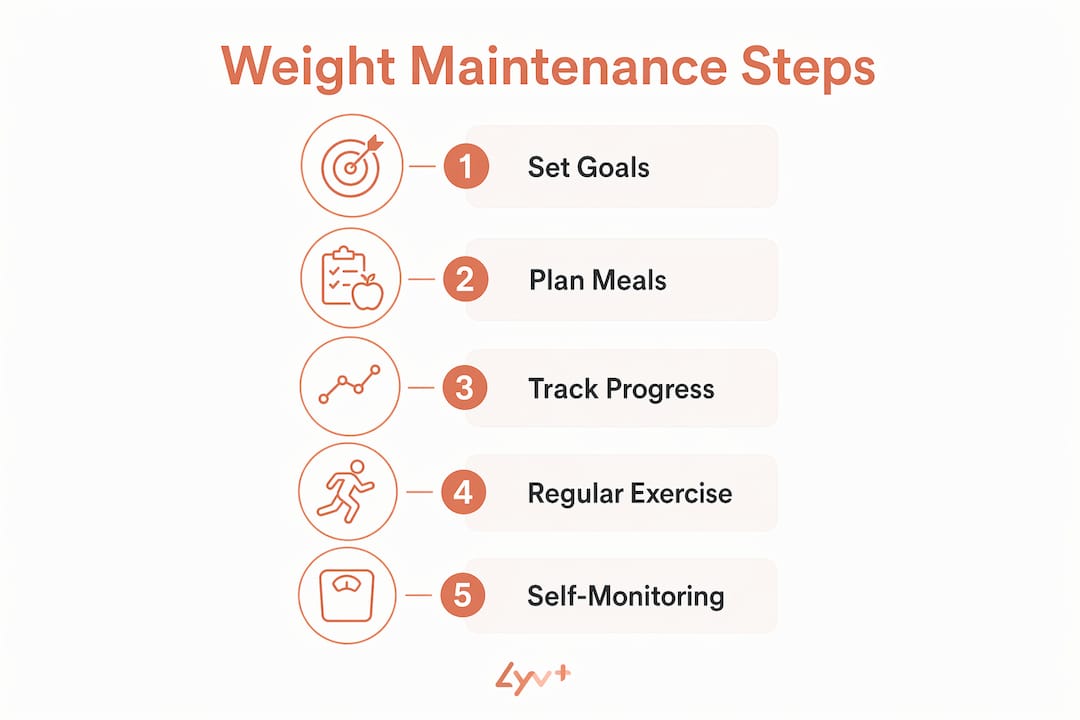
Behaviour is the foundation of keeping weight off. NIHR 2026 guidance identifies ten specific strategies that support weight maintenance, and the most effective ones share a common thread: they are specific, planned, and repeated consistently.
The strategies that make the biggest difference include:
Pro Tip: Set a weekly "check-in" with yourself every Sunday. Review what worked, what did not, and adjust one small thing for the coming week. Consistency beats perfection every time.
Community-based programmes that apply these strategies have achieved over 10% weight loss maintained for up to nine years across diverse populations. That is not a short-term result. It shows that structured behavioural support, applied consistently, produces real and lasting change.

Physical activity is not optional for long-term weight management. It is one of the most reliable tools you have for preventing regain. NHS guidelines recommend 150–250 minutes of moderate to vigorous activity each week to support weight maintenance. The higher end of that range is associated with better outcomes for people who have already lost a significant amount of weight.
The types of activity that work best for weight maintenance include:
The clinical rationale for higher activity levels is straightforward. When you lose weight, your body adapts by reducing its energy expenditure. Physical activity counteracts this adaptation. Without it, the gap between calories consumed and calories burned narrows, and weight creeps back. Integrating movement into your daily routine, rather than treating it as a separate task, makes it far easier to sustain.
Regular monitoring is one of the most underused tools in weight maintenance. Self-weighing supports awareness and allows early detection of regain, giving you the chance to adjust before a small gain becomes a larger one. The key is to treat the number on the scales as information, not a verdict.
Weight fluctuates naturally by 1–2 kg across a single week due to water retention, hormonal shifts, and food volume. Weighing yourself at the same time each day, ideally in the morning, gives you a more accurate picture of your trend over time. A single higher reading is not a failure. A consistent upward trend over two to three weeks is a signal to act.
Pro Tip: Keep a simple weight log in a notebook or a free app. Plot your weekly average rather than daily readings. This smooths out natural fluctuations and shows your real direction of travel.
Food tracking works alongside regular weighing. A food diary, whether written or digital, makes your intake visible. Most people find that the act of recording what they eat changes what they choose to eat. You do not need to track every gram indefinitely. Many people find that tracking for two to four weeks every few months is enough to recalibrate their habits.
The mindset shift that matters most here is treating any upward movement as a learning opportunity. Ask what changed, not what went wrong. That question leads to a practical adjustment. The other question leads to guilt, which rarely helps.
GLP-1 receptor agonists like Wegovy and Mounjaro have changed what is possible in weight management. They reduce appetite, support significant weight loss, and are backed by strong clinical evidence. But the evidence on what happens after stopping them is equally clear. Stopping these treatments00871-8/abstract) leads to rapid regain, with approximately two-thirds of lost weight returning within 12 months. This is not a personal failure. It reflects the biological reality that obesity is a chronic condition, and the hormonal drivers of appetite return when medication stops.
The transition off GLP-1 treatments is a high-risk period that requires planned behavioural interventions, not self-discipline alone. This is where behavioural wraparound care becomes critical. Wraparound care combines clinical assessment, ongoing monitoring, and structured behavioural support delivered in a coordinated way. It is not an add-on. It is the mechanism that makes medication-supported weight loss last.
The NHS Behavioural Support for Obesity Prescribing programme provides structured 9-month support alongside clinical treatment. That duration reflects the time it takes to embed new habits reliably. Medication opens a window of opportunity. Behavioural support is what you build inside that window. You can read more about how GLP-1 treatments work and what to expect from them before, during, and after treatment.
The most common mistake people make after losing weight is treating maintenance as a passive state. It is not. Weight regain is the default biological response when the conditions that produced weight loss are removed. Weight cycling00871-8/abstract), the pattern of losing and regaining repeatedly, is harmful and common without sustained behavioural support. It affects metabolic health and makes subsequent weight loss harder.
The mistakes that most reliably lead to regain include:
Patience and self-compassion are not soft concepts. They are practical tools. People who recover quickly from setbacks, without extended guilt or restriction, maintain their weight more successfully over time. If you want to understand why crash diets fail and what actually works instead, the evidence is consistent and clear.
Maintaining weight loss long-term requires combining consistent behavioural strategies, regular physical activity, structured self-monitoring, and clinical support, especially when pharmacological treatments are involved.
Point - Details
Behavioural strategies are foundational
Setting targets, meal planning, and tracking intake are the habits that prevent regain.
Physical activity prevents metabolic adaptation
150–250 minutes of moderate activity weekly counteracts the body's tendency to regain weight.
Self-monitoring catches regain early
Regular weighing and food tracking give you the data to adjust before small gains become large ones.
Medication alone is not enough
Around two-thirds of weight lost on GLP-1 treatments returns within 12 months of stopping without behavioural support.
Wraparound care makes the difference
Structured clinical and behavioural support, delivered together, produces the most durable outcomes.
The thing that surprises people most is how much of weight maintenance is mental, not physical. The habits are learnable. The food choices are manageable. What trips people up is the expectation that it should feel easy by now.
Maintenance is not the reward for losing weight. It is the next phase of the same work, just with different goals. The people I have seen sustain their results long-term are not the ones with the most willpower. They are the ones who built systems, stayed curious about their data, and stopped treating setbacks as evidence of failure.
The advances in GLP-1 treatments have been genuinely significant. Wegovy and Mounjaro give people access to a level of appetite regulation that was not previously possible without surgery. But the clinical evidence is unambiguous: the biological drivers of regain return when medication stops. That is not a flaw in the medication. It is a feature of how the body works. The answer is not to dismiss medication, and it is not to rely on it exclusively. The answer is to use the window it creates to build the behavioural foundation that lasts.
If I could give one piece of advice to anyone in maintenance, it would be this: weigh yourself regularly, track your food occasionally, and get support from someone who understands both the clinical and behavioural sides of this. You are not failing if it is hard. You are doing something genuinely difficult, and doing it well.
— Lyv
Knowing the strategies is one thing. Having the right support behind you is another.
Lyvpharmacy provides clinician-led access to prescription GLP-1 treatments including Wegovy and Mounjaro, combined with medical oversight designed to support you at every stage. Whether you are currently on treatment, considering it, or planning your next steps after stopping, the right clinical framework makes a measurable difference. Explore Lyvpharmacy's weight loss treatments to see what is available, and read about what clinician-guided care actually means in practice. Real results come from combining the right treatment with the right support.



.jpg)