Registered Pharmacy100% OnlineNew here? Use code: WELCOME10 for 10% OFFFree Shipping Over £50Fully Inspected & Regulated ServicesApproved UK-licensed TreatmentsRegistered Pharmacy100% OnlineNew here? Use code: WELCOME10 for 10% OFFFree Shipping Over £50Fully Inspected & Regulated ServicesApproved UK-licensed Treatments
07 Sep 2026

10min read
Contents

Safe weight loss is defined as losing 0.5–1kg per week through consistent, balanced lifestyle changes rather than crash diets or extreme restrictions. This is the rate recommended by NHS Inform and the British Heart Foundation (BHF), and it matters because faster loss typically means muscle loss, nutritional deficiencies, and rapid weight regain. A proper guide to safe weight loss covers far more than calories. It addresses sleep, stress, movement, mindset, and when to seek professional support. Weight management is a complex, long-term health condition, not a test of willpower, and the strategies that work reflect that reality.
Balanced nutrition is the foundation of any effective weight loss plan. That does not mean cutting entire food groups. The British Dietetic Association (BDA) is clear that viewing diet as a whole produces more sustainable results than eliminating carbohydrates, fats, or any other macronutrient. Build meals around vegetables, fruits, whole grains, lean proteins, and healthy fats, and you create a pattern you can maintain for years, not weeks.

Calorie targets give you a useful starting point. NHS Inform suggests roughly 1,400 kcal per day for women and 1,900 kcal per day for men as a general guide for weight loss, though individual needs vary. These figures are not rigid rules. They are a reference to help you understand whether your current intake is likely to support a deficit.
Physical activity supports weight loss, but not primarily through calorie burn. Sustainable daily movement offers better long-term adherence than short bursts of high-intensity exercise that often lead to burnout. The NHS recommends 150 minutes of moderate-intensity activity per week. That could be brisk walking, cycling, or swimming spread across five days.
Sleep and stress management are often overlooked, but they directly affect your metabolism. Adults need 7–9 hours of sleep per night. Poor sleep raises the hunger hormone ghrelin and lowers leptin, the hormone that signals fullness, making overeating far more likely.
Key habits to build from day one:
Pro Tip: Prepare your meals for the week on a Sunday. People who plan meals in advance eat fewer calories on average and make more nutritious choices under pressure.
Goal-setting separates people who succeed from those who give up after three weeks. Realistic, measurable goals keep you grounded. Aim for 0.5–1kg of loss per week, and set non-scale victories alongside weight targets. Fitting into a specific item of clothing, walking further without breathlessness, or sleeping better are all valid markers of progress.
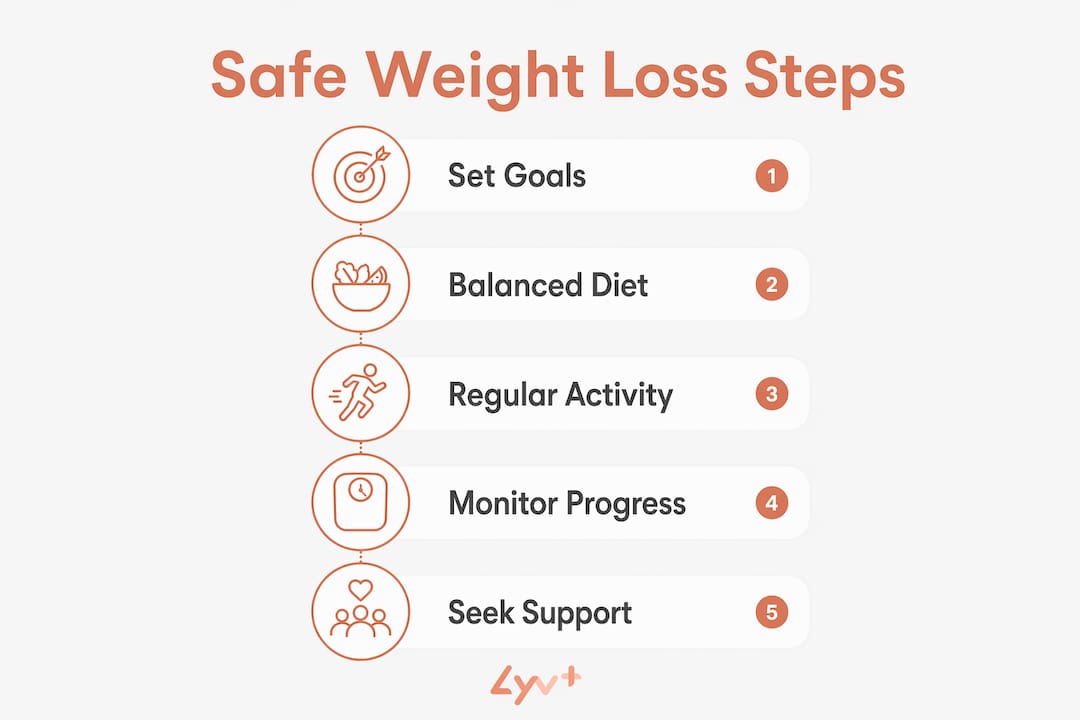
Food diaries are one of the most effective monitoring tools available. Tracking meals at the time you eat improves accuracy and prevents the underestimation that happens with end-of-day recall. You do not need a sophisticated app. A simple notebook works. The act of recording creates awareness, and awareness changes behaviour.
A practical monitoring framework:
Mindful eating is a behavioural technique that complements tracking. Eating without screens or distractions slows your pace and gives your brain time to register fullness. It takes roughly 20 minutes for satiety signals to reach your brain after you start eating. Slowing down is not a small thing. It is one of the most effective calorie-reduction strategies that requires no counting at all.
Pro Tip: Use a smaller plate at every meal. Research from the BDA confirms that environmental strategies like smaller plates reduce intake more sustainably than strict calorie counting alone.
Fad diets are the single biggest obstacle to safe weight loss. The BDA defines a fad diet as any plan that promises rapid results through extreme restriction, elimination of food groups, or unproven supplements. Fad diets often cause nutritional imbalance, leading to weight regain and an unhealthy relationship with food. The weight comes back because the approach was never sustainable in the first place.
"There is no magic solution to losing weight. Sustainable weight loss requires consistent, moderate changes to eating and activity habits over time. Any plan promising otherwise is not grounded in evidence." British Dietetic Association
The all-or-nothing mindset is equally damaging. Many people abandon their plan entirely after one difficult day or a social event where they ate more than intended. Weight loss is not linear. Minor weight regain is normal, and resuming your routine quickly without guilt produces better long-term outcomes than treating a setback as a failure.
Common mistakes to recognise and avoid:
Emotional and environmental triggers drive a significant proportion of overeating. Identifying your personal triggers, whether boredom, stress, or social pressure, gives you the chance to plan a response before the moment arrives.
Social support is one of the strongest predictors of long-term weight loss success. The BHF confirms that support from friends, family, or groups significantly increases adherence compared to self-directed attempts. You do not need to do this alone, and trying to do so often makes the process harder than it needs to be.
Professional guidance adds a layer of accountability and personalisation that general advice cannot replicate. A registered dietitian can assess your specific needs, identify nutritional gaps, and build a plan that fits your life rather than a generic template. A clinician can rule out underlying conditions such as hypothyroidism or polycystic ovary syndrome (PCOS) that may be making weight loss harder than expected.
Benefits of building a support network:
Medically supported treatments are a legitimate option for people with obesity-related health conditions. The BMJ recognises that obesity is a complex, long-term health condition requiring medical support rather than willpower alone. GLP-1 receptor agonists such as Wegovy and Mounjaro, when prescribed appropriately, reduce appetite and support significant weight loss alongside lifestyle changes. These are not shortcuts. They are medical tools for a medical condition.
Pro Tip: If you have a BMI above 30, or above 27 with a weight-related health condition, ask your GP or a clinician-guided service whether prescription treatment is appropriate for you.
Small, consistent changes outperform dramatic overhauls every time. The goal is to make healthy choices the path of least resistance in your daily environment. When your surroundings support good decisions, you rely less on motivation, which is unreliable, and more on structure, which is not.
These steps do not require a gym membership, a meal delivery subscription, or a complete lifestyle overhaul. They require repetition. Habits form through consistent repetition in a stable context, and that is exactly what these daily actions provide.
Safe, sustainable weight loss requires consistent lifestyle changes across nutrition, movement, sleep, and mindset rather than any single dramatic intervention.
Point - Details
Safe rate of loss
Aim for 0.5–1kg per week, as recommended by NHS Inform and the BHF.
Calorie guidance
Roughly 1,400 kcal/day for women and 1,900 kcal/day for men provides a useful starting reference.
Avoid fad diets
The BDA confirms fad diets cause nutritional imbalance and lead to weight regain.
Track in real time
Log meals as you eat them to improve accuracy and build mindful awareness.
Seek support
Social and professional support significantly increases long-term adherence and success.
Weight loss rarely follows the tidy downward curve that diet culture promises. In my experience working alongside clinicians and reading the evidence closely, the people who succeed long-term are not the ones who never slip up. They are the ones who stop treating every setback as a reason to start over from scratch.
The all-or-nothing mindset is the real enemy here. A difficult weekend does not erase three weeks of progress. A missed gym session does not mean the plan has failed. What matters is what you do next. Resuming your routine on Monday morning, without guilt and without punishment, is the single most underrated skill in weight management.
I also think we undervalue the non-scale victories. Blood pressure improving, energy levels rising, sleep becoming more restful. These changes often arrive before the scales move significantly, and they are every bit as meaningful. Viewing weight loss as a health improvement rather than a purely aesthetic goal changes your relationship with the process entirely. It becomes something you do for yourself, not something you do to yourself.
Consistency over perfection. That is the whole thing, really.
— Lyv
If you have tried lifestyle changes and found progress frustratingly slow, or if a health condition is making weight loss harder than it should be, medical support may be the right next step.
Lyvpharmacy provides clinician-led access to prescription GLP-1 treatments including Wegovy and Mounjaro, designed for adults who meet the clinical criteria and want medically proven results. Every patient goes through a clinical assessment before any prescription is issued. There are no shortcuts and no guesswork. You can browse available weight loss treatments online, complete your assessment, and receive discreet home delivery once approved. For those who want to understand the science behind these treatments first, the Lyvpharmacy guide to GLP-1 medications is a clear, honest starting point.