Registered Pharmacy100% OnlineNew here? Use code: WELCOME10 for 10% OFFFree Shipping Over £50Fully Inspected & Regulated ServicesApproved UK-licensed TreatmentsRegistered Pharmacy100% OnlineNew here? Use code: WELCOME10 for 10% OFFFree Shipping Over £50Fully Inspected & Regulated ServicesApproved UK-licensed Treatments
03 Jun 2026

15min read
Contents

By Roxanne Ashley Falzon, CIBTAC Diploma in Laser Hair Removal and Skin Rejuvenation, Specialist on Phyris Cosmetics Clinically reviewed by the Lyv Pharmacy team · 03 June 2026
Once upon a time, a quiet American biochemist called Stanley Cohen noticed that something in cow saliva made baby mice open their eyelids earlier than they were supposed to. He spent the next two decades chasing that “something” through dishes of skin cells. In 1986, he won the Nobel Prize in Medicine for what he found. And, more than thirty years later, the molecule he was chasing is one of the most exciting ingredients in modern skincare.
That molecule is EGF, Epidermal Growth Factor, and it sits at the heart of how brands like Phyris approach anti-ageing today.
This is the in-depth guide we wished existed when our Lyv clients first started asking about EGF: what it actually is, what Phyris does with it, where it fits inside Phyris’s wider anti-ageing technology, and how to use the products at home so you actually see results. Let us get into it.
Epidermal Growth Factor is a small protein, a string of just 53 amino acids, that your body makes naturally and uses to tell skin cells what to do. Specifically, EGF tells skin cells: renew, repair, divide, produce collagen, hold structure. It is, in the friendliest possible terms, the manager who keeps your skin’s factory humming.
When you cut yourself, EGF levels at the site spike. When you produce a baby (whose entire job is to make new tissue out of nothing), EGF turns up in significant quantities in breast milk. When you are young and the skin can repair itself faster than you can damage it, EGF flows freely. The plot twist? From your mid-twenties onwards, your skin’s natural EGF production starts to decline, slowly at first and then more steeply as you age. Combine that with the cumulative damage of sun, pollution, late nights and screen blue light, and you get the visible signs of ageing we all know: fine lines, loss of firmness, slower recovery, duller tone, less bounce.
Topical EGF in skincare aims to top up what your skin is producing less of, signalling to your cells to behave more like they did when you were younger, with measurable results in collagen production, skin thickness, wrinkle reduction and overall radiance.
Pull quote: “EGF is the skincare equivalent of finding the user manual to your own complexion.”
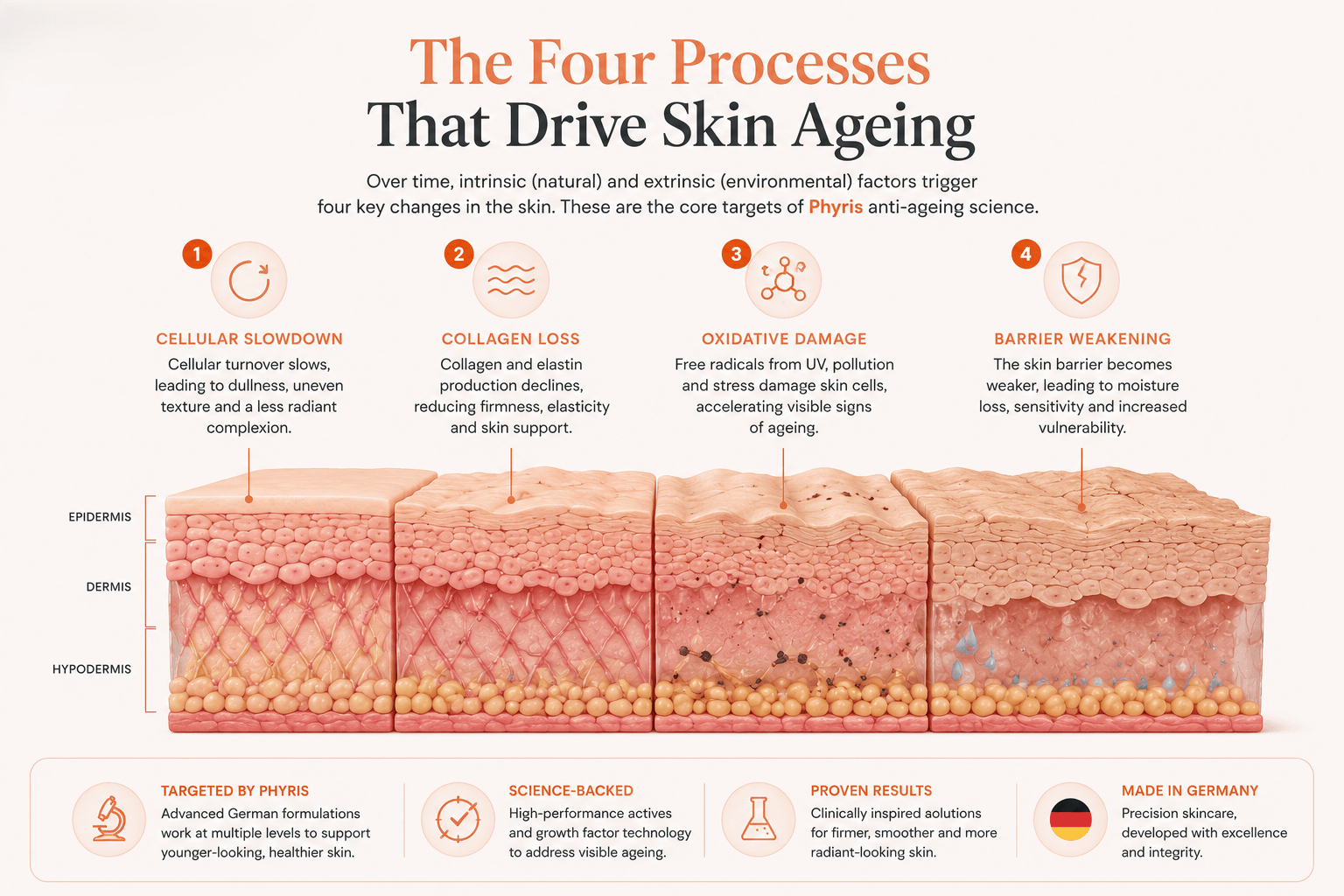
Before we go deeper into Phyris, it helps to understand what is actually going on inside your skin as the years pile up. Skin ageing is not one thing, it is at least four overlapping processes, all happening at the same time:
1. Cellular slowdown. Young skin turns over roughly every 28 days. By your forties, that cycle is closer to 45-50 days, and by your sixties, it can be twice as long. The longer dead cells linger on the surface, the duller, rougher and less radiant the skin looks.
2. Collagen loss. From around age 25, you lose roughly 1% of your dermal collagen per year. By 50, that is a quarter of your structural scaffolding, gone. Collagen loss is what drives loss of firmness, deeper lines, and the sense that the skin is “drooping” rather than “sitting”.
3. Oxidative damage. UV, pollution, smoking, alcohol, sugar and stress all generate free radicals, unstable molecules that damage DNA, lipids and proteins. Over time, this damage compounds. The visible result is uneven tone, hyperpigmentation, broken capillaries and a duller overall finish.
4. Barrier weakening. As skin ages, its lipid barrier becomes thinner, more permeable, and less efficient at holding water. The result: chronic low-grade dehydration that makes lines look deeper, skin feel tight, and active ingredients sting more than they used to.
A serious anti-ageing routine has to deal with all four. Topping up missing signalling molecules (like EGF and peptides), accelerating cellular renewal (retinol, AHAs), neutralising oxidative damage (antioxidants like vitamin C and chaga mushroom), and repairing the barrier (ceramides, hyaluronic acid, fatty acids).
This is exactly the framework Phyris is built around, which is why a properly assembled Phyris anti-ageing routine punches so far above its weight.
If most premium skincare brands attack ageing by throwing one or two hero ingredients at the problem, Phyris takes a more orchestral view. The brand’s anti-ageing philosophy is built around three principles:
1. Multiple actives, multiple mechanisms. Phyris assumes that no single ingredient, even one as potent as EGF or retinol, can address every dimension of skin ageing on its own. So the Phyris ranges combine growth-factor signalling (EGF and EGF-receptor activators), cellular turnover acceleration (retinol, fruit acids), oxidative defence (chaga mushroom, vitamins, peptides), structural support (collagen and elastin stimulators, hyaluronic acid hydration), and barrier restoration (lipids, ceramides, mineral micronutrients).
2. Delivery is half the battle. Pretty much every “active” in skincare is only as good as the formula’s ability to get it to the layer of skin where it can actually work. Phyris is famously obsessive about this. Time-release liposomal encapsulation, multi-lamellar carriers and ingredient pairing all exist to make sure the actives reach the right depth, in the right dose, over the right amount of time.
3. Tolerance matters as much as potency. A 1% retinol that you cannot tolerate for more than three nights is less effective than a 0.3% retinol you can use four times a week for six months. Phyris’s lab thinks in seasons and years, not single applications, and formulates with comfort and consistency in mind. This is why the Time Release range can feel as gentle as moisturiser even when it is working harder than most “extreme” actives in the category.
The result is a portfolio of anti-ageing tools, Time Release, Triple A, Perfect Age, Luxesse, Re and EGF-receptor-activating products, that you can mix and match to build an anti-ageing routine that genuinely shifts your skin over weeks and months.
If we had to pick one Phyris range to talk about anti-ageing, it would be Time Release. This is the heart of Phyris’s anti-ageing science, and it is where some of the smartest delivery technology in professional skincare lives.
What it is. The Time Release range is a family of six serums (and their corresponding mask “depots”), each built around a single hero active wrapped in liposomal time-release encapsulation. The encapsulation does two clever things at once: it carries the active deep into the upper layers of the skin where it can do real work, and it releases the active in a slow, measured way over hours rather than dumping it all at once.
Why this matters. Skin does not love sudden, high concentrations of strong actives, that is where irritation, redness, peeling and “retinol regret” come from. Time Release encapsulation gets you the cumulative effect of a high-dose active without the peak-irritation moment. In real terms, that means more usable nights, less downtime, and better long-term results.
The hero formulas.
The serums layer beautifully with each other (most people use one to three at a time) and with the rest of the Phyris range. Choose your active based on what your skin is asking for that month, and do not be afraid to rotate. Skin gets bored. Variety helps.
When you are ready to step up from a starter retinol like Time Release Retinol Anti-Age, Phyris’s Triple A range is where you go. The “A” stands for retinol (vitamin A), and the range is engineered to deliver clinical-grade retinol with the kind of tolerance you do not normally associate with high-dose retinoid products.
There are three pieces to the trilogy:
The trilogy is designed to be cycled: you will typically start with the cream three times a week, build to nightly use over six to eight weeks, and bring in the mask as needed. The balm slots in when the skin wants more comfort.
A Triple A course over twelve to sixteen weeks is one of the most reliably transformative things you can do at home. We have watched it lift hooded eyelids, blur deep frown lines, even out post-acne pigmentation and resurface sun-damaged cheeks. Patience and consistency are the only two non-negotiables.
Therapist’s note from Roxanne: “I tell every client the same thing about Triple A, do not compete with it. Use it slowly, sleep well while it works, and do not pile other actives on top. Retinol asks for company, not crowds.”

The two more “complete” Phyris anti-ageing ranges are Perfect Age and Luxesse.
Perfect Age is the preventative and early-corrective range. It is aimed at skin that is starting to show first signs of ageing, slightly slower recovery, the beginnings of fine lines, occasional dullness, and at younger skin that wants to protect itself. Active protection against environmental damage, support for cellular regeneration, and the kind of textures that feel like luxurious daily skincare rather than treatment.
Luxesse is the indulgent end of the line, Phyris’s response to the highest-end luxury anti-ageing creams in the market. Triple-action formulas, sumptuous textures, heavyweight actives. Luxesse is the range we would recommend if you are in your forties or beyond, you have established a strong daily routine, and you want a serious moisturiser and treatment system to layer your serums into.
For many of our Lyv clients, the sweet spot looks like this: Time Release serums for targeted nightly actives + Perfect Age or Luxesse for the daily moisturising layer + Triple A in cycles when the skin needs a structural reset + a Phyris facial every four to six weeks to keep momentum.
If you are already familiar with the other big anti-ageing actives, here is how EGF and the Phyris anti-ageing system fit alongside them.
EGF vs retinol. Retinol speeds up cellular turnover, getting old skin off and new skin up faster. EGF works further upstream, signalling cells to repair, divide and produce collagen in the first place. The two work brilliantly together: retinol clears the path, EGF (and EGF-receptor activators) tells the new cells what to do.
EGF vs peptides. Peptides are short chains of amino acids that signal specific actions to skin cells, there are peptides that signal collagen production, others that relax expression lines, others that brighten or firm. EGF is itself a peptide (a relatively long one), and it sits in the same family but at the top of the hierarchy as a master “renew” signal. Most modern formulas use a cocktail of peptides and growth-factor signals working together.
EGF vs vitamin C. Vitamin C is primarily an antioxidant, it neutralises free radicals, protects the skin from oxidative damage, and supports collagen production. EGF is a signalling molecule, not an antioxidant. The two are highly complementary: vitamin C protects what you have, EGF and peptides help you make more.
EGF vs hyaluronic acid. These two work at completely different levels. Hyaluronic acid hydrates and plumps the skin’s water content. EGF signals long-term structural repair. You need both, and Phyris’s product organisation reflects this, the Time Release serums often pair the hero active with hyaluronic acid for exactly this reason.
The big insight: there is no anti-ageing ingredient that does everything. A serious anti-ageing routine combines signalling (EGF, peptides), turnover (retinol, AHAs), protection (vitamin C, antioxidants) and hydration (hyaluronic complex). Phyris’s catalogue is essentially this entire toolkit, ready for you to assemble.

Here is a real-world template for an effective Phyris anti-ageing routine, designed to fit into a busy life rather than monopolise it.
Morning 1. Cleanse with a Phyris cleansing milk or gel. 2. Tonic to rebalance. 3. SOMI, TERMASOMI to amplify actives, or SENSISOMI if your skin is reactive. 4. Antioxidant serum, a vitamin-led Time Release like Vitamin Flash, or a Time Release Ceramide Repair if the barrier needs work. 5. Moisturiser, Perfect Age or Luxesse for richer, AQUActive Hyaluron Cream for lighter. 6. Eye care, a Phyris Eye Zone product. 7. Broad-spectrum SPF 50, the single most important anti-ageing product in your life, full stop.
Evening 1. Double cleanse, oil or milk first, then a gel. 2. Tonic. 3. Active treatment, this is the headline step. Time Release Retinol Anti-Age 2-4 nights a week (rising gradually), Triple A Retinol Cream on stronger nights, Hyaluron Super Moist on hydration nights. Do not combine all three at once, rotate. 4. Optional: a second serum layered for hydration or comfort. 5. Night cream, Triple A Retinol Cream, Luxesse, Perfect Age, or a Phyris recovery cream if you are post-treatment. 6. Eye care, a richer eye product is fine at night.
Weekly extras - Triple A Retinol Mask once a week if your skin tolerates it. - A hydrating mask (e.g. AQUActive Hyaluron Sensation Mask or FoREST Mask) on alternating weeks. - A Phyris professional facial every four to six weeks if you can.
If you would like a routine genuinely designed for your skin, book a free virtual consultation with our Lyv specialists, we will map out a plan based on what your skin is doing right now, not what it was doing five years ago.
A decade of facial chairs has taught us the same handful of patterns. The good news is they are all fixable.
1. Stacking too many actives at once. New retinol + new acid + new vitamin C + new growth-factor serum in one weekend? Your skin will revolt. Introduce one new active at a time and give it three weeks before adding the next.
2. Quitting too early. Anti-ageing skincare is a twelve-week minimum game. Most actives do not show their full effect until at least week eight. If you have used a retinol for ten days and decided it is “not working”, you have not used a retinol.
3. Skipping SPF. No anti-ageing routine works without a high-grade daily sunscreen. We will repeat this until we are blue in the face.
4. Treating without hydrating. Strong actives need a strong barrier underneath them. Without proper hydration (AQUActive, hyaluronic complex, ceramide repair) your skin will become reactive, your actives will sting, and you will quit prematurely. See mistake #2.
5. Inconsistency. Anti-ageing skincare is like fitness, twelve weeks of three-times-a-week beats two weeks of nightly followed by a long break. Sustainability is everything.
6. Ignoring the rest of your life. Sleep, sugar, alcohol, stress and sun exposure all do more to your skin than any cream. Skincare amplifies a healthy life, it does not replace one.
Lyv tip: If you can change three things, daily SPF, an evening retinol three nights a week, and seven hours of sleep, you will be more effective than 90% of people who own a bathroom shelf full of products.
Final word from Lyv: Anti-ageing skincare is not about reversing time. It is about giving your skin the tools to keep doing its best work, for as long as possible. Phyris is one of the smartest toolkits we have found. Shop the Phyris Time Release and Triple A ranges or book a free virtual consultation and let us get your skin’s future started.
Disclaimer: This article is for informational purposes only and is not intended as medical advice. Do not introduce new active ingredients during pregnancy or breastfeeding without consulting a healthcare professional. If you have a specific skin condition, please consult a qualified healthcare provider or one of our Lyv Pharmacy specialists.
holds a CIBTAC Diploma in Laser Hair Removal and Skin Rejuvenation and is a certified Specialist in Phyris Cosmetics. She works with Lyv Pharmacy clients on anti-ageing strategy, professional facial protocols, and at-home routine design. Her clinical specialism is in retinol tolerance protocols and treatment-led skin transformation.