Registered Pharmacy100% OnlineNew here? Use code: WELCOME10 for 10% OFFFree Shipping Over £50Fully Inspected & Regulated ServicesApproved UK-licensed TreatmentsRegistered Pharmacy100% OnlineNew here? Use code: WELCOME10 for 10% OFFFree Shipping Over £50Fully Inspected & Regulated ServicesApproved UK-licensed Treatments
15 Sep 2026

9min read
Contents

Outcome-focused weight loss is defined as an approach that prioritises measurable health improvements and personalised goals over simply reducing the number on the scale. Rather than chasing a target weight, you focus on what that weight loss actually does for your body and your life. The NICE 2026 guidelines classify overweight and obesity as chronic conditions requiring personalised, long-term management. That shift in thinking changes everything. Functional goals such as fitting into your clothes more comfortably, climbing stairs without breathlessness, or reducing your risk of type 2 diabetes become the real measures of progress. This is what results-oriented weight loss looks like in practice.
Outcome-focused weight loss centres on achieving specific, meaningful health results rather than hitting an arbitrary number. The standard industry term for this approach is "outcomes-based weight management," and it sits at the heart of modern clinical practice. Where traditional dieting asks "how much weight can I lose?", this approach asks "what do I want my body to be able to do?"
The distinction matters because functional goals such as playing actively with grandchildren or walking without joint pain carry real motivational weight. They are concrete, personal, and deeply connected to quality of life. A number on the scale is not. When your goal has genuine meaning, you are far more likely to stay the course.

This approach also reflects how medicine now understands obesity. Treating it as a short-term problem to be solved with a crash diet ignores the biology involved. Treating it as a chronic condition requiring ongoing, personalised support is both more accurate and more effective. The science-based approach to weight management reflects exactly this shift.
Several core principles separate this approach from conventional dieting. Understanding them helps you build a plan that actually holds up over time.
Pro Tip: Write down three things you want to be able to do physically that feel difficult right now. Use those as your primary goals, and let weight loss be the mechanism, not the destination.
Putting this approach into practice involves structured steps, the right level of support, and a realistic timeline. Here is how it works.
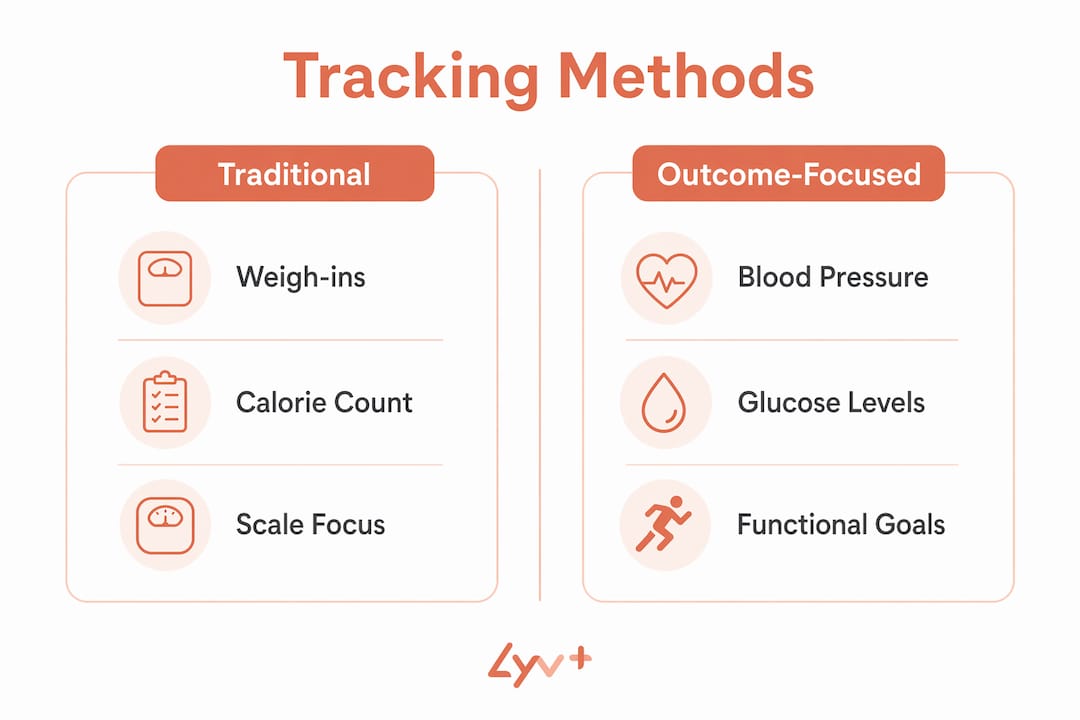
The table below shows how outcome-focused monitoring differs from traditional weight loss tracking.
Traditional tracking - Outcome-focused tracking
Weekly weigh-ins only
Blood pressure, glucose, and mobility checks
Calorie counting as the primary tool
Behavioural and dietary pattern review
Success defined by scale weight
Success defined by functional and clinical improvements
Short-term diet cycles
Long-term lifestyle and support plan
Ongoing engagement with healthcare professionals and multidisciplinary teams significantly improves adherence and functional outcomes. That consistency of support is what separates a plan that lasts from one that fades after six weeks.
Pro Tip: Ask your GP or clinician to track at least two non-scale markers at every review, such as blood pressure and waist circumference. Seeing those numbers improve keeps motivation strong even when weight loss slows.
The advantages of this approach go well beyond the physical. They affect how you feel, how you think about food, and how sustainable your results are.
"Shifting focus from weight to health outcomes helps reduce mental strain and promotes realistic goal attainment. When the goal is to feel better and move more freely, progress becomes visible long before the scales reflect it."
This is not just a philosophical shift. It is a clinically supported change in how weight management is delivered. The clinician-guided approach to weight loss reflects this evidence directly, combining medical oversight with personalised goal-setting.
No approach is without its difficulties. Knowing what to expect makes it far easier to stay on track.
Pro Tip: Keep a simple weekly log of three functional markers: how far you walked, how your energy felt, and one non-scale health observation. Reviewing this over months shows real progress that the scale often misses.
The core concepts of weight management are worth revisiting regularly, especially during periods when motivation dips. Understanding the "why" behind your plan makes it easier to push through the harder weeks.
Outcome-focused weight loss works because it replaces arbitrary scale targets with personalised, clinically meaningful goals that sustain motivation and produce lasting health improvements.
Point - Details
Definition is clear
Outcome-focused weight loss prioritises health results over scale weight alone.
NICE 2026 guidelines support it
Overweight and obesity are classified as chronic conditions needing long-term, personalised management.
Functional goals drive motivation
Goals like climbing stairs or reducing diabetes risk are more motivating than a target weight.
Multidisciplinary support matters
Specialist services combining nutrition, psychology, and medicine improve adherence and outcomes.
Weight regain is expected
Anticipating setbacks and refocusing on health markers keeps long-term progress on track.
The conversation around weight loss has been dominated by one number for far too long. I have seen it repeatedly: people who lose significant amounts of weight, feel better, move better, and have improved blood results, yet still describe themselves as failing because the scale did not move as fast as they hoped.
The outcome-focused model is not new in clinical circles. What is new is the willingness to bring it into mainstream conversations. The NICE 2026 guidelines formalising obesity as a chronic condition are a significant step. They validate what good clinicians have known for years: that sustainable weight management requires ongoing support, personalised goals, and a much broader definition of success.
The hardest part is not the diet or the exercise. It is persuading yourself that feeling better, sleeping more soundly, and walking further without pain are genuine victories. They are. In fact, they are the victories that last. The scale catches up eventually, but those functional gains are what change your life day to day.
If you are in your 40s or 50s and have tried multiple approaches without lasting results, the missing piece is almost always the goal itself. When the goal is meaningful and personal, the effort required to reach it becomes sustainable. That is not motivational language. That is what the evidence consistently shows.
— Lyv
Lyvpharmacy is built around exactly the kind of clinician-led, outcome-focused approach described throughout this article. Every patient starts with a clinical assessment, and treatment is matched to individual health needs rather than a generic plan.
For adults who want access to prescription GLP-1 treatments such as Wegovy and Mounjaro, Lyvpharmacy provides fast, regulated access with medical oversight at every stage. These treatments work by reducing appetite and supporting meaningful weight loss when used as part of a broader health plan. You can explore the full range of clinically approved weight loss treatments available through Lyvpharmacy, with discreet home delivery and repeat prescription support included. The focus is always on real, sustainable results, not short-term fixes.
Recommended