Registered Pharmacy100% OnlineNew here? Use code: WELCOME10 for 10% OFFFree Shipping Over £50Fully Inspected & Regulated ServicesApproved UK-licensed TreatmentsRegistered Pharmacy100% OnlineNew here? Use code: WELCOME10 for 10% OFFFree Shipping Over £50Fully Inspected & Regulated ServicesApproved UK-licensed Treatments
12 Sep 2026

10min read
Contents

Fast access weight loss is defined as the rapid initiation of clinically approved, medically supervised treatment to reduce body weight, distinct from fad diets or unregulated supplements. The phrase has become common in UK health marketing, but its meaning depends entirely on the route you take. Through the NHS, "fast" can mean waiting over a year. Through a regulated private provider, it can mean a clinical assessment within days. Understanding this distinction is the first step to making a genuinely informed decision. This guide explains what fast access really means, how NHS and private pathways compare, and how to pursue rapid weight loss safely under proper medical oversight.
Fast access weight loss refers to getting into a medically supervised weight loss programme as quickly as possible, not to losing weight overnight. The industry term for this is "accelerated clinical access," and it covers everything from GP referrals to private online consultations. Speed matters because GLP-1 receptor agonists like Wegovy and Mounjaro have shown meaningful clinical results, and delays in access mean delays in health outcomes.

The key distinction is between marketing language and clinical reality. A provider promising "instant" weight loss medication is almost certainly misrepresenting the process. Prescription-only medicines require a verified medical history, BMI confirmation, and clinical sign-off before any treatment begins. That process takes time, even when it is done efficiently.
Nearly 10% of adults in Britain have recently used or want to use weight loss drugs, including GLP-1 based medications. That level of demand has created a market where speed is used as a selling point, sometimes at the expense of safety. Knowing what legitimate fast access looks like protects you from both poor care and wasted money.
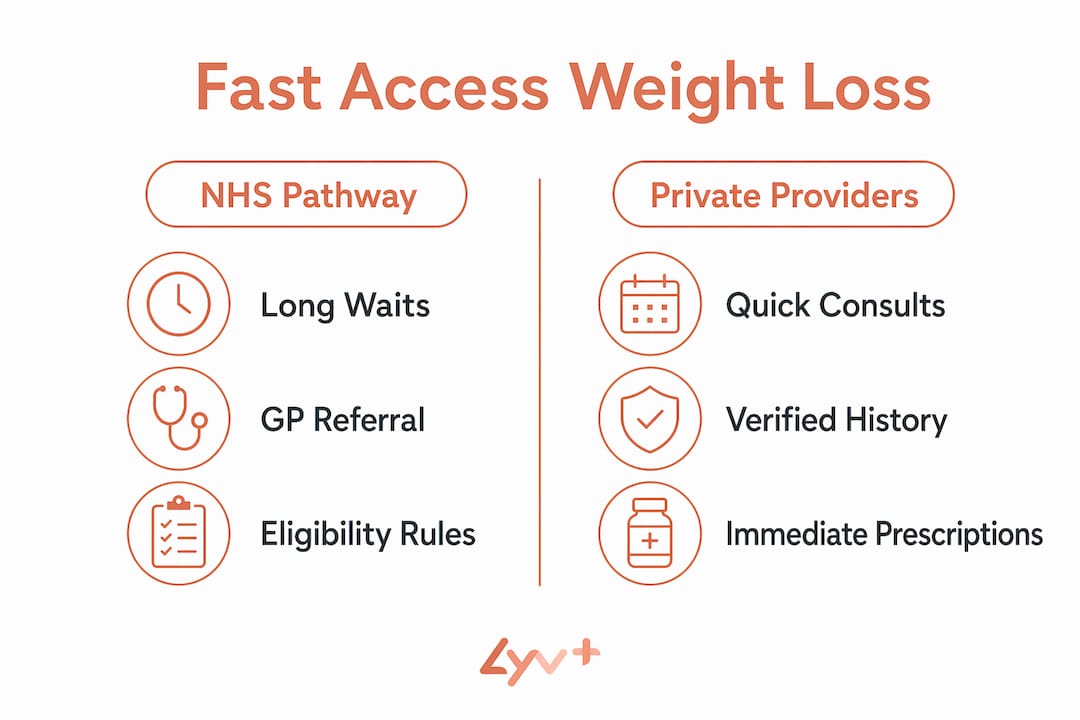
The NHS pathway for weight loss medication is a multi-step clinical process. It begins with a GP referral, moves through assessment by a specialist multidisciplinary team, and depends on commissioning decisions made by your local Integrated Care Board. Each step adds time, and the cumulative wait is significant.
NHS waiting times for Tier 3 weight management services range from 12 to 24 months or more in many areas. Some services are temporarily closed to new referrals entirely due to demand. That is not a failure of individual GPs. It reflects a system under pressure from a rapidly growing patient population.
Eligibility on the NHS is governed by NICE technology appraisal TA1026. To qualify for medications like Wegovy, you generally need a BMI of 30 or above, or 27 or above with a weight-related health condition such as type 2 diabetes or hypertension. Meeting those criteria does not guarantee a short wait. It simply means you are eligible to join the queue.
The government has responded with a £85 million investment into AI-assisted triage and neighbourhood health hubs, aiming to improve access for over 85,000 patients over three years. That is a positive development, but it will not resolve current backlogs overnight.
Key NHS pathway steps at a glance:
Pro Tip: Start your NHS referral as early as possible, even if you are also exploring private options. Getting onto the NHS list now means you have a clinical safety net while you assess other routes.
Private providers can offer faster initial consultations, sometimes within 24 to 48 hours. That speed is real and valuable. What it does not mean is that you can bypass the clinical requirements that exist to keep you safe.
Private providers legally must verify your medical history and confirm eligibility before prescribing. Paying privately does not guarantee that treatment will start immediately. Many patients do not meet the BMI or comorbidity thresholds set by NICE guidelines and are declined after assessment. That outcome, while disappointing, is the correct one. Prescribing to ineligible patients creates serious health risks. GPhC inspection reports have found that some private weight loss providers fail to conduct meaningful clinical assessments. A questionnaire alone is not sufficient. Legitimate prescribing requires a thorough review of your health history, current medications, and relevant conditions.
What to look for in a private provider:
Pro Tip: Before booking with any private provider, search their name on the GPhC register. If they are not listed, do not proceed. Unregistered providers operate outside the law.
Digital pharmacy services can genuinely improve access and convenience, but they must maintain clinical standards equal to face-to-face services. The best private providers combine speed of access with rigour of assessment.
UK law prohibits advertising prescription-only medicines directly to the public. This is not a minor technicality. It is a firm legal boundary enforced by both the MHRA and the Advertising Standards Authority. Any provider making bold claims about "fast access" to specific named prescription medications is likely breaching CAP Code Rule 12.12, which bans the promotion of prescription medicines to consumers.
Enforcement actions from the MHRA and ASA are increasing in response to illicit marketing in the weight loss sector. Providers caught making misleading claims face warnings, fines, and removal of their ability to operate. That regulatory pressure is a good thing. It pushes legitimate providers to focus on clinical consultation and support rather than headline promises.
"Advertising that promotes specific prescription weight loss medicines directly to the public, or claims 'rapid, guaranteed' weight loss, is prohibited under CAP Code Rule 12.12. MHRA and ASA enforcement actions are increasing in response to illicit marketing in this space."
What this means for you as a patient is straightforward. If a provider's website is full of dramatic before-and-after claims and promises of instant results, treat that as a warning sign. Legitimate services promote the clinical process, not the outcome speed.
Steps to verify a provider's legitimacy:
Advertising restrictions lead legitimate providers to focus on promoting clinical consultation and support rather than medication or rapid results claims. That focus is a reliable indicator of a trustworthy service.
The fastest safe route to weight loss treatment is a prepared, well-informed approach. Knowing your BMI, understanding your eligibility, and having your medical history ready before your first consultation saves time at every stage. You can check fast track prescription options to understand what the approval process involves before you start.
Weight loss medications like Wegovy and Mounjaro are approved for BMI 30 or above, or 27 or above with a relevant health condition. They are not cosmetic treatments. They are part of a comprehensive medical programme that includes dietary guidance, behavioural support, and regular clinical review. Rapid, unsupervised weight loss can cause loss of muscle and bone mass. Medical supervision is not bureaucracy. It is the mechanism that protects your long-term health while you lose weight. A supervised programme monitors your nutrient balance, adjusts your dose, and catches problems early.
Practical steps for safe, fast access:
Pro Tip: Set realistic weight loss goals before you start treatment. Patients who enter programmes with clear, measurable targets tend to stay engaged and achieve better outcomes.
Fast access weight loss is achievable through regulated clinical pathways, but speed must never come at the cost of proper medical assessment and ongoing supervision.
Point - Details
Define "fast access" correctly
It means rapid entry into a supervised clinical programme, not instant medication without assessment.
NHS waits are long
Tier 3 services have waiting times of 12–24 months or more in many areas; start the referral early.
Private routes require clinical checks
Paying privately does not bypass eligibility criteria; GPhC and CQC registration are non-negotiable.
Advertising claims signal risk
Providers promoting specific prescription medicines or guaranteed results are likely breaching UK law.
Supervision protects your health
Unsupervised rapid weight loss risks muscle and bone loss; medical oversight is a clinical necessity.
The most common mistake I see is treating "fast access" as a finish line rather than a starting point. Patients spend weeks researching which provider is quickest, then arrive at their first consultation without knowing their BMI, their current medications, or whether they have any conditions that affect eligibility. That preparation gap adds more delay than the provider's process ever would.
The second pattern I notice is a deep frustration with the NHS that is entirely understandable but sometimes leads to poor decisions. When someone has waited 18 months and still has no appointment, the appeal of a provider promising results in days is obvious. But the providers making those promises are often the ones cutting corners on assessment. The frustration is valid. The solution is not.
What actually works is choosing a private provider with genuine clinical rigour, one that asks hard questions, reviews your full history, and has a clinician available after your prescription starts. That process might take a few days longer than a form-and-ship operation, but it is the version that keeps you safe and produces results that last. Speed and safety are not opposites. The right provider delivers both.
— Lyv
Lyvpharmacy is built for people who want medically proven results without the NHS wait or the risk of unregulated providers. Every patient goes through a structured clinical assessment before any prescription is issued, and all treatments are dispensed through a GPhC-registered pharmacy with full medical oversight.
The range of weight loss treatments available through Lyvpharmacy includes GLP-1 medications such as Wegovy and Mounjaro, prescribed only where clinically appropriate. Consultations are fast, the assessment is thorough, and home delivery is discreet. If you want to understand more about how GLP-1 medications work before you start, the GLP-1 medication guide covers everything you need to know in plain language.